Asian Art
Kingdom of Kush
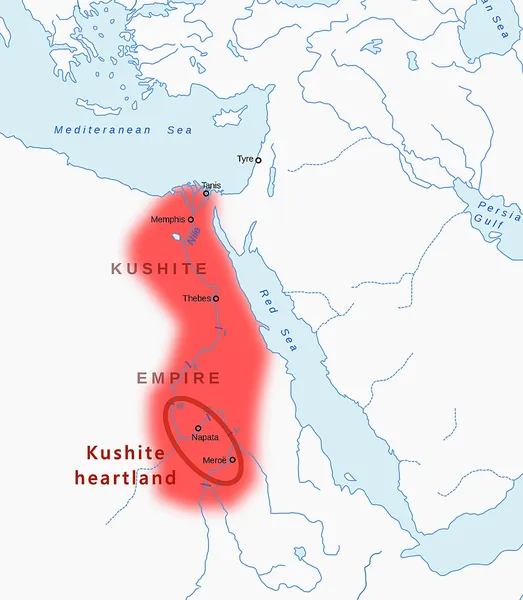
The Kingdom of Kush, also known as the Kushite Empire, or simply Kush, was an ancient kingdom in Nubia, centered along the Nile Valley in what is now northern Sudan and southern Egypt. The region of Nubia was an early cradle of civilization, producing several complex societies that engaged in trade and industry. The city-state of Kerma emerged as the dominant political force between 2450 and 1450 BC, controlling the Nile Valley between the first and fourth cataracts, an area as large as Egypt. The Egyptians were the first to identify Kerma as "Kush" probably from the indigenous ethnonym "Kasu", and over the next several centuries the two civilizations engaged in intermittent warfare, trade, and cultural exchange. Much of Nubia came under Egyptian rule during the New Kingdom period (1550–1070 BC). Following Egypt's disintegration amid the Late Bronze Age collapse, the Kushites reestablished a kingdom in Napata (now modern Karima, Sudan). Though Kush had developed many cultural affinities with Egypt, such as the veneration of Amun, and the royal families of both kingdoms occasionally intermarried, Kushite culture, language and ethnicity was distinct; Egyptian art distinguished the people of Kush by their dress, appearance, and even method of transportation. In the 8th century BC, King Kashta ("the Kushite") peacefully became king of Upper Egypt, while his daughter, Amenirdis, was appointed as divine adoratrice of Amun in Thebes. His successor Piye invaded Lower Egypt, establishing the Kushite-ruled Twenty-fifth Dynasty. Piye's daughter, Shepenupet II, was also appointed divine adoratrice of Amun. The monarchs of Kush ruled Egypt for over a century until the Assyrian conquest, being dethroned by the Assyrian kings Esarhaddon and Ashurbanipal in the mid-7th century BC. Following the severing of ties with Egypt, the Kushite imperial capital was located at Meroë, during which time it was known by the Greeks as Aethiopia. The northernmost part of Nubia was occupied from the 3rd century BC to the 3rd century AD, first by the Ptolemaic Kingdom and then by the Roman Empire. At the end of this 600-year period, the territory, known in the Greco-Roman world as Dodekaschoinos, was taken back by the Kushite king Yesebokheamani.
Also on this shelf
Bonseki.
British Raj.
See also
Uncatalogued shelfText from Wikipedia; plate via Wikimedia Commons. Text CC BY-SA 4.0; plate freely licensed (see Commons). Source record. Images and catalogue data are reproduced from open-access collections.