Asian Art
Chinese herbology
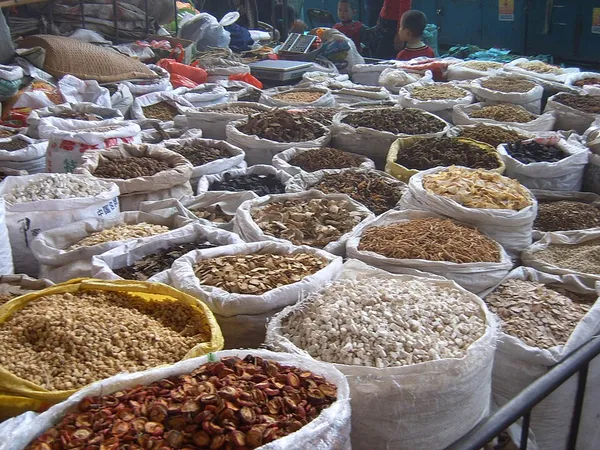
Chinese herbology or Chinese materia medica (traditional Chinese: 中藥學; simplified Chinese: 中药学; pinyin: zhōngyào xué; lit. 'Chinese medication study') is the theory of traditional Chinese pharmacotherapy, which accounts for the majority of treatments in traditional Chinese medicine (TCM). It is analogous to other traditional materia medica systems. The term herbology is misleading in the sense that, while plant elements are by far the most commonly used substances, animal, human, and mineral products are also used, some of which are poisonous. In the Huangdi Neijing they are referred to as 毒藥 (pinyin: dúyào) which means "poison-medicine". Paul U. Unschuld points out that this is similar etymology to the Greek pharmakon and so he uses the term pharmaceutic. Thus, the term medicinal (instead of herb) is usually preferred as a translation for 藥 (pinyin: yào). A Nature editorial described TCM as "fraught with pseudoscience", and said that the most obvious reason why it has not delivered many cures is that the majority of its treatments have no logical mechanism of action. Research into the effectiveness of traditional Chinese medicinal therapy is of poor quality and often tainted by bias, with little or no rigorous evidence of efficacy. There are concerns over a number of potentially toxic Chinese medicinals, including Aristolochia which is thought to cause cancer.
Also on this shelf
Dhadi (music).
Goldwork (embroidery).
See also
Uncatalogued shelfText from Wikipedia; plate via Wikimedia Commons. Text CC BY-SA 4.0; plate freely licensed (see Commons). Source record. Images and catalogue data are reproduced from open-access collections.