Asian Art
Chinese playing cards
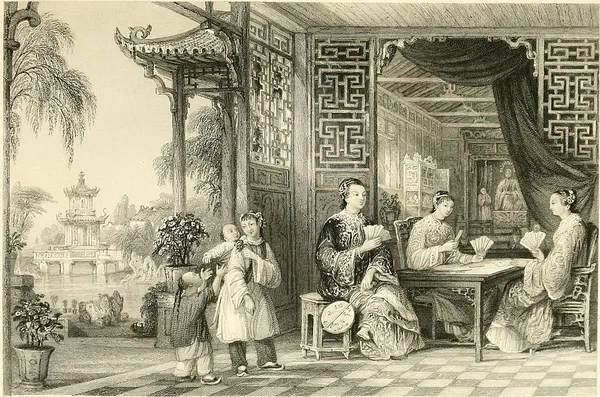
Playing cards (simplified Chinese: 纸牌; traditional Chinese: 紙牌; pinyin: zhǐpái) were most likely invented in China during the Southern Song dynasty (1127–1279). They were certainly in existence by the Mongol Yuan dynasty (1271-1368). Chinese use the word pái (牌), meaning "plaque", to refer to both playing cards and tiles. Many early sources are ambiguous, and do not specifically refer to paper pái (cards) or bone pái (tiles); but there is no difference in play between these, as either serves to hide one face from the other players with identical backs. Many western scholars, like William Henry Wilkinson, Stewart Culin, Thomas F. Carter, and Michael Dummett attribute to the Chinese the invention of playing cards. Michael Dummett also contends that the concept of suits and the idea of trick-taking games were invented in China. Trick-taking games eventually became multi-trick games. These then evolved into the earliest type of rummy games during the eighteenth century. By the end of the monarchy, the vast majority of traditional Chinese card games were of the draw-and-discard or fishing variety. Chinese playing cards have been spread into Southeast Asia by Chinese immigrants.
Also on this shelf
History of science and technology in the People's Republic of China.
Brush pot.
See also
Uncatalogued shelfText from Wikipedia; plate via Wikimedia Commons. Text CC BY-SA 4.0; plate freely licensed (see Commons). Source record. Images and catalogue data are reproduced from open-access collections.