Asian Art
Guru Granth Sahib
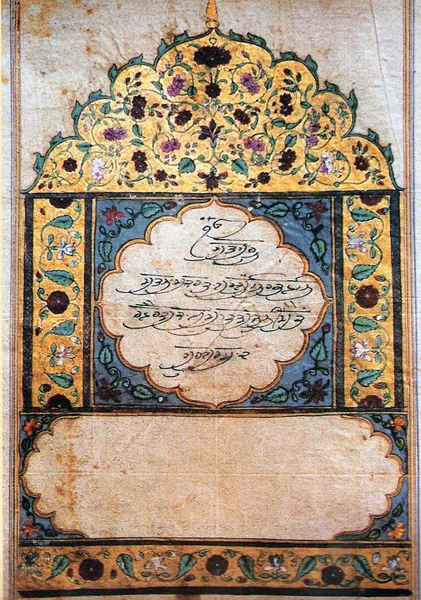
The Guru Granth Sahib (Punjabi: ਗੁਰੂ ਗ੍ਰੰਥ ਸਾਹਿਬ, pronounced [ɡʊɾuː ɡɾənt̪ʰᵊ säː(ɦ)(ɪ)bᵊ(˦)]) is the central holy religious scripture of Sikhism, regarded by Sikhs as the final, sovereign, and eternal Guru following the lineage of the ten human gurus of the religion. The Adi Granth (Punjabi: ਆਦਿ ਗ੍ਰੰਥ), its first rendition, was compiled by the fifth guru, Guru Arjan (1564–1606). Its compilation was completed on 29 August 1604 and first installed inside the Golden Temple in Amritsar on 1 September 1604. Baba Buddha was appointed the first Granthi of the Golden Temple. Later, Guru Gobind Singh, the tenth Sikh guru, added hymns of Guru Tegh Bahadur to the Adi Granth and affirmed the text as his successor on 6 October 1708. This second rendition became known as the Guru Granth Sahib and is also sometimes referred to as the Adi Granth. The text consists of 1,430 angs (pages) and 5,894 shabads (line compositions), which are poetically rendered and set to a rhythmic ancient north Indian classical form of music. The bulk of the scripture is divided into 31 main rāgas, with each Granth rāga subdivided according to length and author. The hymns in the scripture are arranged primarily by the rāgas in which they are read. The Guru Granth Sahib is written in the Gurmukhi script in various languages including Punjabi, Lahnda, regional Prakrits, Apabhramsa, Sanskrit, Hindi languages (Braj Bhasha, Bangru, Awadhi, Old Hindi), Bhojpuri, Sindhi, Marathi, Marwari, Bengali, Persian and Arabic. Copies in these languages often have the generic title of Sant Bhasha. The Guru Granth Sahib was composed predominantly by six Sikh gurus: Guru Nanak, Guru Angad, Guru Amar Das, Guru Ram Das, Guru Arjan and Guru Tegh Bahadur. It also contains the traditions and teachings of fourteen Hindu Bhakti movement sants (saints), such as Ramananda, Kabir and Namdev among others, and one Muslim Sufi saint: Sheikh Farid. The vision in the Guru Granth Sahib is of a society based on divine freedom, mercy, love, and justice without oppression of any kind. While the Granth acknowledges and respects the scriptures of Hinduism and Islam, it does not imply a moral reconciliation with either of these religions. It is installed in a Sikh gurdwara (temple). A Sikh typically prostrates before it on entering such a temple. The Granth is revered as eternal gurbānī and the spiritual authority in Sikhism.
Also on this shelf
Bnei Menashe.
Child cannibalism.
See also
Uncatalogued shelfText from Wikipedia; plate via Wikimedia Commons. Text CC BY-SA 4.0; plate freely licensed (see Commons). Source record. Images and catalogue data are reproduced from open-access collections.