Asian Art
History of Taiwan
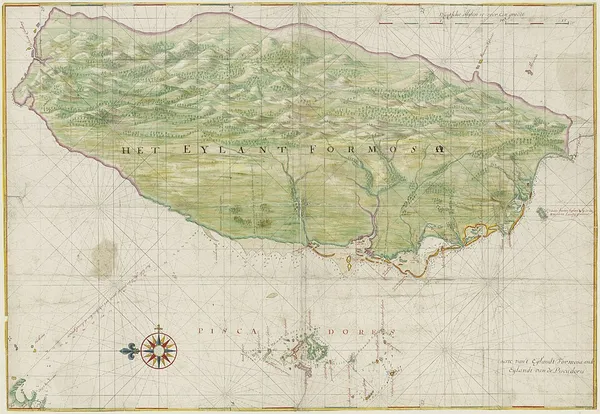
The history of the island of Taiwan dates back tens of thousands of years to the earliest known evidence of human habitation. The appearance of a culture based on agriculture around 3000 BC is believed to reflect the arrival of the ancestors of today's Taiwanese indigenous peoples. People from China gradually came into contact with Taiwan by the time of the Yuan dynasty (1271–1368) and Han Chinese people started settling there on a larger scale by the early 17th century. The island became known by the West when Portuguese explorers discovered it in the 16th century and named it Formosa. Between 1624 and 1662, the south of the island was colonized by the Dutch headquartered in Zeelandia in present-day Anping, Tainan whilst the Spanish built an outpost in the north, which lasted until 1642 when the Spanish fortress in Keelung was seized by the Dutch. These European settlements were followed by an influx of Hoklo and Hakka immigrants from Fujian and Guangdong. In 1662, Koxinga defeated the Dutch and established a base of operations on the island. His descendants were defeated by the Qing dynasty in 1683 and their territory in Taiwan was annexed by the Qing dynasty. Over two centuries of Qing rule, Taiwan's population increased by over two million and became majority Han Chinese due to illegal cross-strait migrations from mainland China and encroachment on Taiwanese indigenous territory. Due to the continued expansion of Chinese settlements, Qing-governed territory eventually encompassed the entire western plains and the northeast. This process accelerated in the later stages of Qing rule when settler colonization of Taiwan was actively encouraged. The Qing ceded Taiwan and Penghu to Japan after losing the First Sino-Japanese War in 1895. Taiwan experienced industrial growth and became a productive rice- and sugar-exporting Japanese colony. During the Second Sino-Japanese War it served as a base for invasions of China, and later Southeast Asia and the Pacific during World War II. In 1945, following the end of hostilities in World War II, the nationalist government of the Republic of China (ROC), led by the Kuomintang (KMT), took control of Taiwan. The legality and nature of its control of Taiwan, including transfer of sovereignty, is debated.
Also on this shelf
East Asian Yogācāra.
East Mountain Teaching.
See also
Uncatalogued shelfText from Wikipedia; plate via Wikimedia Commons. Text CC BY-SA 4.0; plate freely licensed (see Commons). Source record. Images and catalogue data are reproduced from open-access collections.