Asian Art
Empress Myeongseong
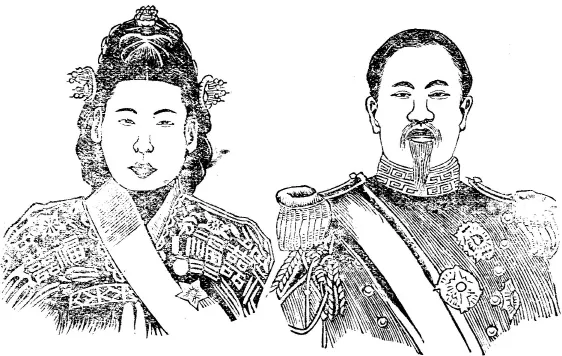
Empress Myeongseongtae (Korean: 명성태황후; Hanja: 明成太皇后; 17 November 1851 – 8 October 1895), of the Yeoheung Min clan, personal name Min Ja-yeong, commonly known as Empress Myeongseong, was the wife of Gojong, the 26th king of Joseon and the first emperor of the Korean Empire. She was queen of Joseon from 1866 until her assassination in 1895. Known as Queen Min during her lifetime, she was posthumously honored as empress following the establishment of the Korean Empire. Queen Min was of aristocratic background and in 1866 was selected by the regent Heungseon Daewongun (Grand Internal Prince Heungseon) to marry his son, the newly enthroned King Gojong. Seven years later, his chosen daughter-in-law and her Min clan forced him out of office. The Daewongun was a conservative Confucianist later implicated in an unsuccessful rebellion against his daughter-in-law's faction. He believed that isolating Joseon from all foreign contact was a means of preserving independence. She, by contrast, was a believer in gradual modernisation using Western and Chinese help. From 1873 to her assassination in 1895 she oversaw economic, military and governmental modernisation. In the 1880s and 1890s the relationship between Joseon and neighbouring Japan deteriorated. The queen was considered an obstacle by the government of Meiji Japan to its overseas expansion. She had taken a firmer stand against Japanese influence after her father-in-law's failed rebellion that intended to remove her from the political arena. Miura Gorō, the Japanese Minister to Korea, backed the faction headed by the Daewongun and directly ordered her assassination. On 8 October 1895, the Hullyŏndae regiment loyal to the Daewongun attacked Gyeongbokgung and overpowered its royal guards. The intruders then allowed a group of rōnin, specifically recruited for this purpose, to assassinate the queen. Her assassination sparked international outrage. In the winter of 1895–1896, the Japanese-backed cabinet ordered Korean men to cut off their topknots. This caused uproar, because the hairstyle was considered a badge of Korean identity. This edict and the assassination provoked nationwide protests. Gojong and the crown prince (later Emperor Sunjong) accepted refuge in the Russian legation in 1896.
Also on this shelf
0s BC.
Bhaisajyaguru.
See also
Uncatalogued shelfText from Wikipedia; plate via Wikimedia Commons. Text CC BY-SA 4.0; plate freely licensed (see Commons). Source record. Images and catalogue data are reproduced from open-access collections.