Asian Art
Emperor Tenji
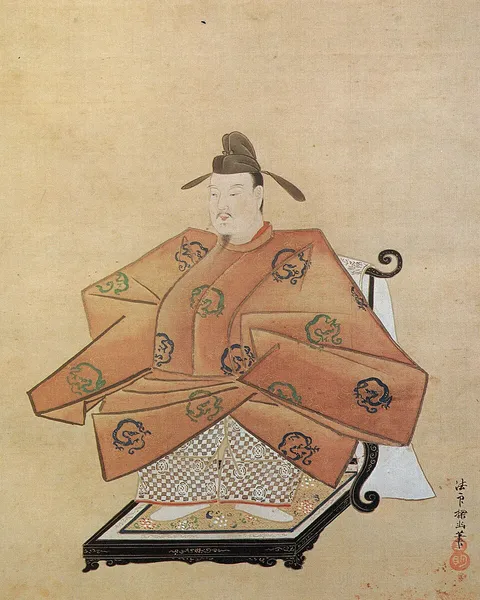
Emperor Tenji (also romanized Tenchi, 626–671) was the 38th emperor of Japan according to the traditional order of succession. Initially known as Prince Kazuraki, and later Prince Naka no Ōe, he was the son of Emperor Jomei and Empress Kōgyoku. After his father's death in 641, the young Prince Naka entered into a succession dispute with another imperial prince, Yamashiro. To mediate, Empress Kōgyoku ascended the throne. Naka conspired with a group of aristocrats to assassinate the authoritarian minister Soga no Iruka in 645. After the assassination, Kōgyoku resigned as ruler and was succeeded by her brother (Naka's uncle), Emperor Kōtoku, who appointed Naka as his heir. However, after Kōtoku's death in 654, Kōgyoku reascended the throne as Empress Saimei. She died in 661 amid preparations for an expedition to Korea, where the forces of Tang China and Silla defeated those of Japan. Prince Naka did not immediately ascend to the throne, instead serving as regent for the following seven years. During his term as regent, Naka implemented reforms to the imperial court and built up military infrastructure in Kyushu, fearing a Chinese invasion. He moved the capital to the Ōmi Ōtsu Palace northeast of Asuka, after which he ascended to the throne as emperor. He established the Daijō-kan (Council of State), appointing his son Prince Ōtomo as the inaugural Daijō-daijin ('prime minister'), and allegedly ordered the compilation of the first version of the Ritsuryō law code. He fell ill and died in 671, prompting a succession dispute between Prince Ōtomo and Tenji's brother, Prince Ōama. It is unknown which Tenji wished to succeed him. The dispute broke out into a brief civil war, which ended with the victory of Ōama, who then ruled as Emperor Tenmu. Tenji was not memorialized under Tenmu's reign, but was given a burial tumulus in 700 under the reign of his daughter, Empress Jitō. The 8th-century history chronicle Nihon Shoki dedicates relatively little coverage to Tenji's reign, although it emphasizes his importance during the reigns of his predecessors. He received poems in honor of him in the 8th-century anthologies Man'yōshū and Kaifūsō, including a cycle of nine banka elegies. Tenji's reign at Ōmi was traditionally portrayed as a golden age for art and culture, although this was likely overstated by later chroniclers.
Also on this shelf
Baba Darbara Singh.
1798.
See also
Uncatalogued shelfText from Wikipedia; plate via Wikimedia Commons. Text CC BY-SA 4.0; plate freely licensed (see Commons). Source record. Images and catalogue data are reproduced from open-access collections.