Asian Art
Hariti
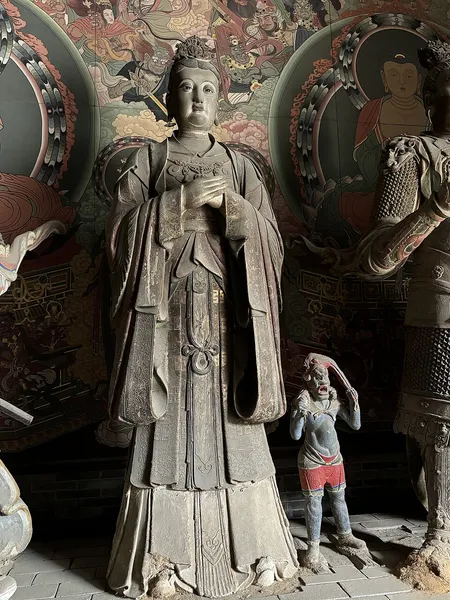
Hārītī (Sanskrit), also known as Chinese: 鬼子母(神); pinyin: Guǐzǐmǔ(shén), Japanese: 鬼子母神, romanized: Kishimojin, is a female rākṣasī or yakṣinī (nature spirit) in Buddhism. She appears as a character in all Buddhist traditions and she is revered as a fierce Dharma Protector and a fertility goddess in Mahayana Buddhism. Hārītī appears in various Mahayana sutras, including in the Lotus Sutra, where she vows to protect those who uphold the sutra. She is also mentioned as a protector in the Candragarbhasūtra. In East Asian Buddhism, she is respected as a dharmapala. In Chinese Buddhism, she is typically considered as one of the Twenty-Four Protective Deities. In Japanese Buddhist traditions such as Shingon and Nichiren, she is revered as a deity of fertility and easy childbirth. Meanwhile in the Vajrayana tradition of Nepalese Buddhism she is also revered as a protection goddess. In the Mahayana tradition, she is associated with fertility, the protection of children, easy delivery and happy child rearing. She is also known to scare irresponsible parents and unruly children. In some Asian folk traditions, her darker side as causing terror to children is sometimes emphasized.
Also on this shelf
Hans Christian Andersen.
Gongfu tea.
See also
Uncatalogued shelfText from Wikipedia; plate via Wikimedia Commons. Text CC BY-SA 4.0; plate freely licensed (see Commons). Source record. Images and catalogue data are reproduced from open-access collections.