Asian Art
Bertrand Russell
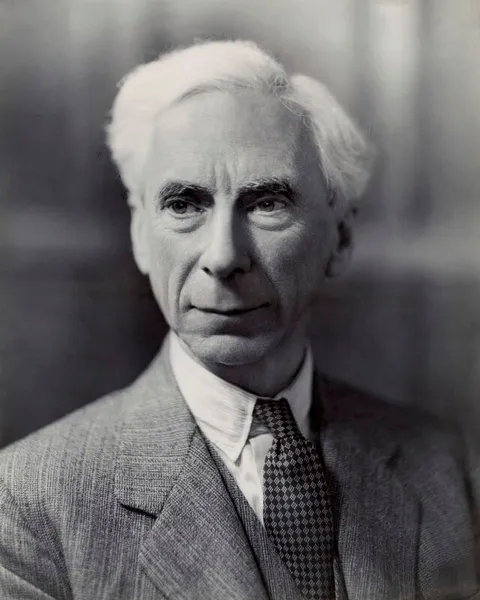
Bertrand Arthur William Russell, 3rd Earl Russell (18 May 1872 – 2 February 1970), was an English mathematician and philosopher. A founder of analytic philosophy, he was a leading philosopher of the 20th century who produced pioneering work in logic, set theory, and philosophy of language. Russell popularised philosophy to the general public and was a controversial figure for his outspoken atheism, pacifism, and opposition to nuclear weapons. Despite his extensive contributions to mathematics, Russell was more known to the public for his books and commentary on several social and political issues. A grandson of John Russell, 1st Earl Russell, a former prime minister of the United Kingdom, Russell was orphaned at the age of four and raised primarily by his grandmother Frances. He won a scholarship to Trinity College, Cambridge, where he studied mathematics and graduated with a first-class degree in 1893. Russell was initially an adherent of British idealism, the dominant philosophy of the time. His friendship with G. E. Moore, a professor of philosophy at Cambridge, led him to analytic philosophy. In Moore and Russell's "revolt against idealism", he rejected dialectic, monism, and idealism and championed logical analysis and pluralism. Russell was one of the early 20th century's prominent logicians and a founder of analytic philosophy, along with his predecessor Gottlob Frege, his friend and colleague G. E. Moore, and his student and protégé Ludwig Wittgenstein. Russell with Moore led the British "revolt against idealism". Together with his former teacher Alfred North Whitehead, Russell wrote Principia Mathematica, a milestone in the development of classical logic and a major attempt to reduce the whole of mathematics to logic (see logicism). Russell's article "On Denoting" has been considered a "paradigm of philosophy". Russell was a pacifist who championed anti-imperialism and chaired the England-based India League. He went to prison for his pacifism during the First World War, and he initially supported appeasing Adolf Hitler's Nazi Germany, before changing his view in 1943, describing war as a necessary "lesser of two evils". In the wake of the Second World War, he welcomed American global hegemony in preference to either Soviet hegemony or no (or ineffective) world leadership, even if it were to come at the cost of using their nuclear weapons.
Also on this shelf
Caofeidian, Tangshan.
Hòn non bộ.
See also
Uncatalogued shelfText from Wikipedia; plate via Wikimedia Commons. Text CC BY-SA 4.0; plate freely licensed (see Commons). Source record. Images and catalogue data are reproduced from open-access collections.