Asian Art
Decan
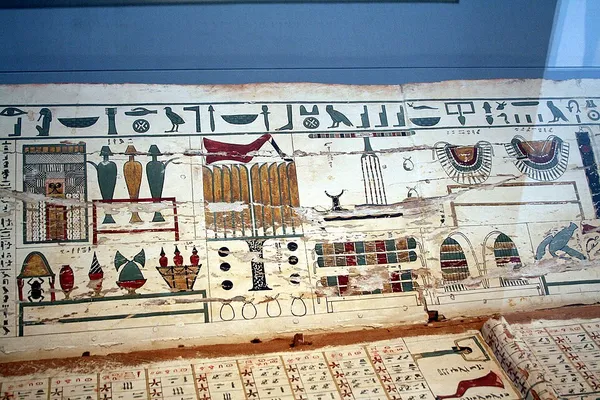
The decans (; Ancient Egyptian: 𓅡𓎡𓏏𓁐𓅱𓏼, romanized: bꜣkt.w, lit. '[those] connected with work') are 36 groups of stars (small constellations) used in ancient Egyptian astronomy to conveniently divide the 360 degree ecliptic into 36 parts of 10 degrees each, both for theurgical and heliacal chronometrical purposes. The decans each appeared, geocentrically, to rise consecutively on the horizon throughout each daily Earth rotation. The rising of each decan marked the beginning of a new decanal "hour" (Greek hōra) of the night for the ancient Egyptians, and they were used as a nocturnal (sidereal clock) beginning by at least the Ninth or Tenth Dynasty of Egypt in the 21st century BC. Because a new decan also appears heliacally every ten days (that is, every ten days, a new decanic star group reappears in the eastern sky at dawn right before the Sun rises, after a period of being obscured by the Sun's light), the Greeks called them dekanói (Koine Greek: δεκανοί; pl. of δεκανός dekanós) or "tenths". Decans gave way to a lunar division of 27 or 28 lunar stations, also known as manzil (Arabic: مَنْزِل), lunar stations, or nakshatras and thence to a zodiac of twelve signs, based on an anthropomorphic pattern of constellations, and their use can be seen in the Dendera zodiac dated to circa 50 BCE.
Also on this shelf
Gu Yanwu.
Goyō Hashiguchi.
See also
Uncatalogued shelfText from Wikipedia; plate via Wikimedia Commons. Text CC BY-SA 4.0; plate freely licensed (see Commons). Source record. Images and catalogue data are reproduced from open-access collections.