Asian Art
Haile Selassie
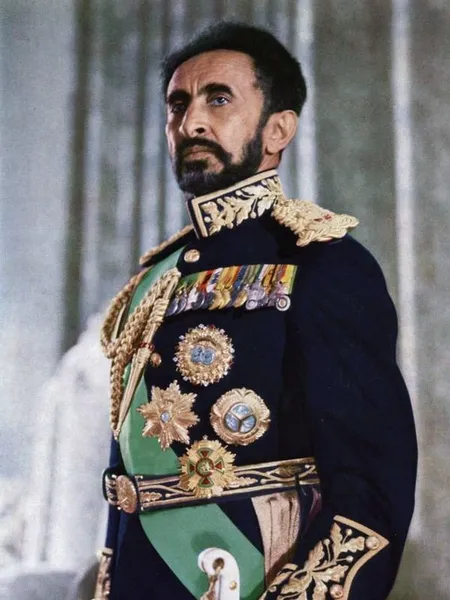
Haile Selassie I (born Tafari Makonnen or Lij Tafari; 23 July 1892 – 27 August 1975) was Emperor of Ethiopia from 1930 to 1974. He rose to power as the Regent Plenipotentiary of Ethiopia (Enderase) under Empress Zewditu between 1916 and 1930. Widely considered to be a defining figure in modern Ethiopian history, he is accorded divine importance in Rastafari, an Abrahamic religion that emerged in the 1930s. A few years before he began his reign over the Ethiopian Empire, Selassie defeated Ethiopian army commander Ras Gugsa Welle Bitul, nephew of Empress Taytu Betul, at the Battle of Anchem. He belonged to the Solomonic dynasty, founded by Emperor Yekuno Amlak in 1270. Selassie, seeking to modernise Ethiopia, introduced political and social reforms including the 1931 constitution and the abolition of slavery in 1942. He led the empire during the Second Italo-Ethiopian War, and after its defeat was exiled to the United Kingdom. When the Italian occupation of East Africa began, he traveled to Anglo-Egyptian Sudan to coordinate the Ethiopian struggle against Fascist Italy; he returned home after the East African campaign of World War II. He dissolved the Federation of Ethiopia and Eritrea, established by the United Nations General Assembly in 1950, and annexed Eritrea as one of Ethiopia's provinces, while also fighting to prevent Eritrean secession. As an internationalist, Selassie led Ethiopia's accession to the United Nations. In 1963, he presided over the formation of the Organisation of African Unity, the precursor of the African Union, and served as its first chairman. By the early 1960s, prominent African socialists such as Kwame Nkrumah envisioned the creation of a "United States of Africa". Their rhetoric was anti-Western; Selassie saw this as a threat to his alliances. He attempted to influence a more moderate posture within the group. Amidst popular uprisings, Selassie was overthrown by the Derg, a military junta, in the 1974 coup d'état. With support from the Soviet Union, the Derg began governing Ethiopia as a Marxist–Leninist state. In 1994, three years after the fall of the Derg regime, it was revealed to the public that the Derg had assassinated Selassie at the Jubilee Palace in Addis Ababa on 27 August 1975.
Also on this shelf
Horseshoe.
Hongwu Emperor.
See also
Uncatalogued shelfText from Wikipedia; plate via Wikimedia Commons. Text CC BY-SA 4.0; plate freely licensed (see Commons). Source record. Images and catalogue data are reproduced from open-access collections.