Asian Art
Economy of Armenia
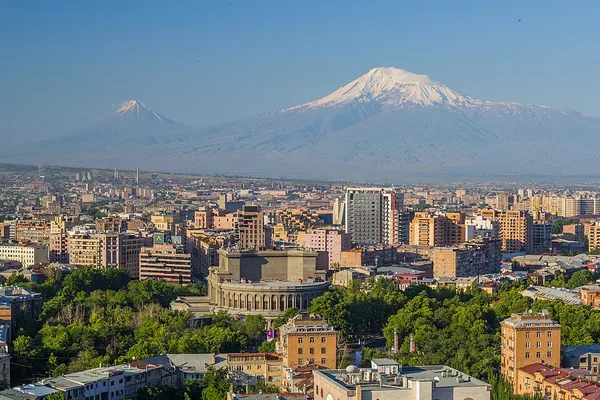
Armenia has an emerging free-market economy. It is the 116th-largest economy in the world, with an estimated gross domestic product (GDP) of almost $32 billion by nominal value and almost $83 billion in terms of purchasing power parity (PPP). The service sector is the largest in Armenia's economy, contributing 61.4% of the country's total GDP, followed by the industrial sector at 23.3%, and the agricultural sector at 7.9%. A smaller, but increasingly important piece of the economy is the IT sector, which makes up 6.25% of national GDP and was growing at an average yearly rate of 20% as of 2022. As a former member of the Soviet Union, Armenia's economy was subjected to rigorous central planning, with the USSR driving large-scale industrialization efforts throughout the entire union. This greatly sped up the transition of Armenia's economy from primarily agrarian to a more modern, industrial economy. Some of the most prominent manufacturing industries during this time were chemicals, electronics, machinery, processed food, synthetic rubber and textiles. The Soviet period also saw a large expansion of Armenia's mining industry, exploiting domestic deposits of copper, zinc, gold, lead, and bauxite for export to other parts of the Soviet Union. After gaining independence in 1991, the economy shifted heavily away from the state-run model and saw rapid privatization throughout the economy. The economic shock caused by the breakup of the Soviet Union, along with the conflict with Azerbaijan over the ethnic Armenian-dominated region of Nagorno-Karabakh, contributed to a severe economic decline in the early 1990s. Armenia recovered from this collapse in the decades that followed with a period of rapid economic growth; the size of the economy tripled by the end of the decade from the post-war low of 1994, and it grew an additional 500% in the 2000s. In 2015, Armenia joined the Eurasian Economic Union, which has expanded its international trade opportunities and made the economy more competitive. However, despite these tailwinds, geopolitical concerns—namely hostile relations with Azerbaijan and heavy reliance on Russia—continue to pose significant risks to Armenia's future economic prosperity. Owing to a relative lack of domestic natural resources, Armenia needs to import large amounts of raw materials and energy resources to sustain its economy.
Also on this shelf
British Raj.
Brihadisvara Temple.
See also
Uncatalogued shelfText from Wikipedia; plate via Wikimedia Commons. Text CC BY-SA 4.0; plate freely licensed (see Commons). Source record. Images and catalogue data are reproduced from open-access collections.