Asian Art
Dodge WC series
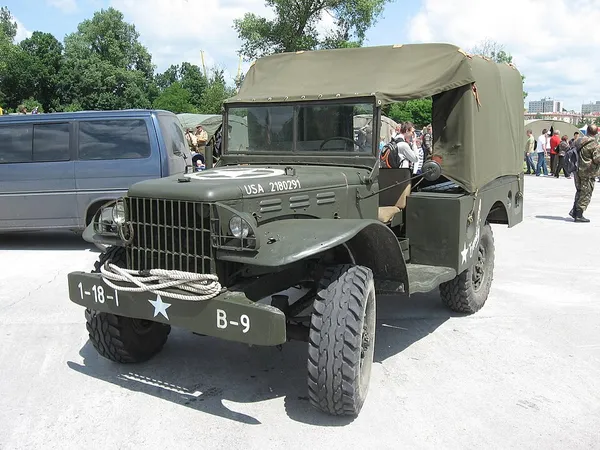
The Dodge WC series, nicknamed "Beeps", and at first (from 1940 to 1942) nicknamed jeeps, is a prolific range of light 4WD and medium 6WD military utility trucks, produced by Chrysler under the Dodge and Fargo marques during World War II. Together with the later 1⁄4‑ton jeeps produced by Willys and Ford, the Dodge 1⁄2‑ton G-505 and 3⁄4‑ton G-502 trucks made up nearly all of the light 4WD trucks supplied to the U.S. military in WW II – with Dodge contributing some 337,500 4WD units (over half as many as the 1⁄4‑ton jeeps). Contrary to the versatility of the highly standardized 1⁄4‑ton jeeps, which was mostly achieved through field modification, the Dodge WC‑series came in many different, purpose-built, but mechanically uniform variants from the factory, much akin to the later family of High Mobility Multipurpose Wheeled Vehicles. The WC series evolved out of, and was part of a more extended family of trucks, with great mechanical parts commonality, that included open- and closed-cab cargo, troops and weapons carriers, (radio) command, and reconnaissance cars, ambulances, carry-alls, panel vans, and mobile telephone installation and (emergency) field workshop trucks. The Dodge WC series were essentially built in two generations. From 1940 to early 1942, almost 82,400 of the 1⁄2‑ton 4×4 Dodge trucks were built. Initially called the VC series (for 1940), these were the U.S. military's first ever "light" four-wheel drive, (pre)-production trucks, preceding the momentous 1940 rethink, leading to the creation of the "1⁄4-ton truck". However, the great majority, from the 1941 model year, were named WC series, and built in more variants. Contrary to what Dodge's nomenclature maybe suggested, the 1941 WC models were a straight evolution of the 1940 VC models, retaining their G-505 U.S. Army Ordnance Corps' Supply Catalog number. For 1942, the trucks bodies and chassis were largely redesigned – heavier frames and drivetrains uprated them to carry 3⁄4‑tons off-road. And widening their tracks, while greatly shortening the wheelbase on the main models, plus lowering the bodies' center of gravity, gave them a much more square stance, with a much better break-over angle and side-slope stability.
Also on this shelf
Culture of Vietnam.
Dashuhua.
See also
Uncatalogued shelfText from Wikipedia; plate via Wikimedia Commons. Text CC BY-SA 4.0; plate freely licensed (see Commons). Source record. Images and catalogue data are reproduced from open-access collections.