Asian Art
Imam Reza Shrine
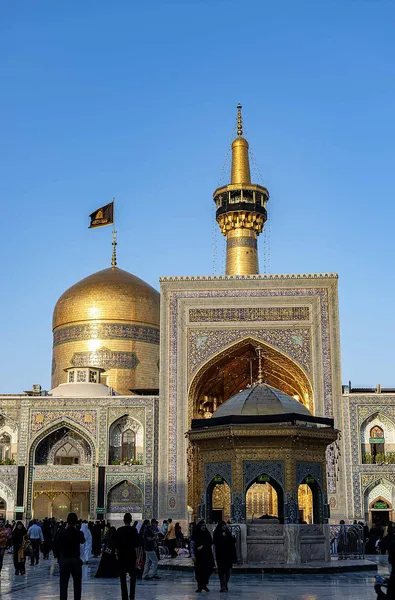
The Imam Reza shrine (Persian: حرم امام رضا, romanized: Haram-e Emâm Rezâ, lit. 'Sanctuary of Imam Reza') is the mausoleum of Ali al-Rida, the eighth Imam in Shia Islam, located in Mashhad, the province of Razavi Khorasan, Iran. As one of the holiest sites in Shia Islam, nearly 30 million Muslims making pilgrimages to the shrine every year, the most visited pilgrimage site in Islam. Imam Reza was a descendant of the Islamic prophet Muhammad. His lineage traces back to Ali via Muhammad’s daughter Fatima, through the line of Husayn. He is part of the chain of mystical authority in Sunni Sufism, making him widely respected in Sunni Islam as well. He is also regarded as a model of asceticism in Sufism. Uyoun Akhbar Al-Ridha have recorded miracles which have occurred at the shrine. The shrine covers an area of 1,200,000 square meters, making it the third largest mosque in the world, after Masjid al-Haram in Mecca and the Prophet's Mosque in Medina. The Goharshad Mosque, the Astan Quds Razavi Central Museum, The Central Library of Astan Quds Razavi, and the Razavi University of Islamic Sciences, are also contained within the complex. The complex was added to Iran's National Heritage List on 6 January 1932, and on 2 February 2017, it was added to Iran's tentative list of UNESCO World Heritage Sites. Also buried within the shrine are members of the Timurid, Safavid and Qajar dynasties, alongside the Abbasid caliph Harun al-Rashid, polymath Sheikh Bahāʾī, Crown Prince Abbas Mirza, Supreme Leader Ali Khamenei, and many other notable political figures, scholars, and clerics. The city of Mashhad has been named the Cultural Capital of the Islamic World by the Organisation of Islamic Cooperation.
Also on this shelf
Daqin.
Dazu Rock Carvings.
See also
Uncatalogued shelfText from Wikipedia; plate via Wikimedia Commons. Text CC BY-SA 4.0; plate freely licensed (see Commons). Source record. Images and catalogue data are reproduced from open-access collections.