Asian Art
Hyundai Motor Company
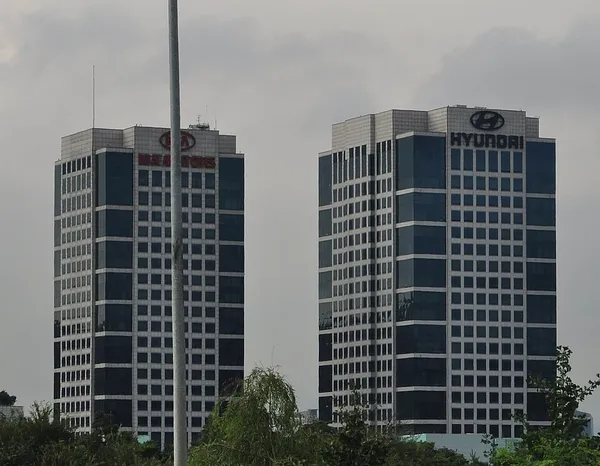
Hyundai Motor Company, often referred to as Hyundai Motors (Korean: 현대자동차) and commonly known as Hyundai (현대; [çəːndɛ]; 'modernity'), is a South Korean multinational automotive manufacturer established in 1967. Currently, the company owns 33.88 percent of Kia Corporation, and owns a luxury cars subsidiary, Genesis. The three brands altogether make up the Hyundai Motor Group. Headquartered at the Hyundai Motor Group complex in Seoul, Hyundai operates the world's largest single integrated automobile manufacturing facility in Ulsan, South Korea. Established in 1968, the Ulsan plant spans approximately 5,000,000 m²—about 670 football fields—and employs around 31,000 workers, with an annual completed-vehicle production capacity of 1.52 million units. The company employs approximately 75,000 people worldwide. Hyundai vehicles are sold in 193 countries through 5,000 dealerships and showrooms. As of November 2024, Hyundai is the world's third-largest carmaker in terms of production, behind competitors Toyota and Volkswagen. Hyundai's product portfolio includes passenger cars, SUVs, commercial vehicles and hydrogen fuel-cell vehicles sold under the Hyundai marque alongside its Genesis luxury division and the Ioniq and N sub-brands. Recent technology and product initiatives include battery-electric vehicles based on the Electric-Global Modular Platform (E-GMP) and continued hydrogen fuel-cell development. In 2025, Hyundai sold about 4.14 million vehicles worldwide and reported record annual revenue of ₩186.3 trillion, while operating profit declined to ₩11.47 trillion amid tariff and competitive pressures.
Also on this shelf
Fatimid Caliphate.
Foreign relations of China.
See also
Uncatalogued shelfText from Wikipedia; plate via Wikimedia Commons. Text CC BY-SA 4.0; plate freely licensed (see Commons). Source record. Images and catalogue data are reproduced from open-access collections.