Asian Art
Legalism (Chinese philosophy)
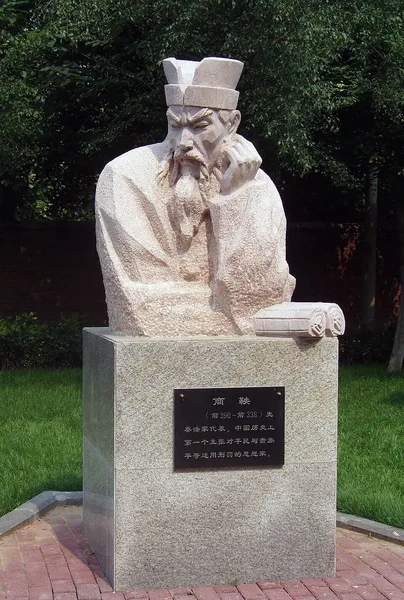
Legalism (Chinese: 法家; pinyin: fǎjiā) refers to an intellectual, political, and philosophical orientation beginning in the Warring States period of China. While heterogeneous, the Legalists generally shared a view of most people—or at least the elite—as fundamentally self-interested, emphasizing equality under the law, administrative methods, and regulations. In addition, the Legalists tended to view the strengthening of agriculture and the military as the primary concern of the state, and they advocated for reducing the power of the aristocracy in favor of meritocracy and limiting the direct interference in the affairs of state by the sovereign. The Legalist emphasis on pragmatic, results-driven governance put them at odds with the Confucians, who advocated for cultivated virtue as a primary method of building a well-governed state, as well as the Mohists, who supported an egalitarian society driven by universal love. While the core Legalist thinkers heavily criticised Confucianism and Mohism, their relationship with Daoism was much more complex. Some legalist thinkers, such as Han Fei (considered by many to be the greatest Legalist thinker), were greatly influenced by Daoism, and drew inspiration from the Daoist concept of Wu wei (non-action) to describe their ideal of a ruler who retreated from active management of the state in favor of setting universal rules and standards. The confluence of Legalist and Daoist ideas is referred to as Huang-Lao, which was the dominant ideology of the early Han dynasty. Legalist ideas first saw institutional adoption in Qin state, under Shang Yang's reforms in the 4th century BCE. These reforms, such as providing fiefs based on military performance and punishing farmers who failed to meet quotas, would become instrumental in Qin's conquest of China and establishment of China's first imperial dynasty.
Also on this shelf
Cebu (historical polity).
Ding Ling.
See also
Uncatalogued shelfText from Wikipedia; plate via Wikimedia Commons. Text CC BY-SA 4.0; plate freely licensed (see Commons). Source record. Images and catalogue data are reproduced from open-access collections.