Asian Art
Economic history of Japan
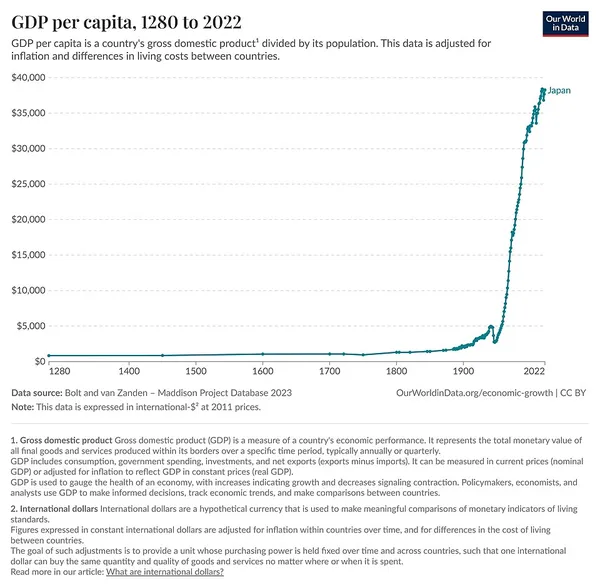
The economic history of Japan concerns the development of the economy of Japan from ancient times to the present. Early Japanese society was primarily agricultural, although trade with mainland Asia introduced new technologies and cultural influences. Following the rise of the Imperial House and increasing political centralization, Japan developed systems of taxation, administration, and currency influenced by China, including the introduction of the Wadōkaichin coinage during the classical period. During the era of Feudal Japan, improvements in agriculture and commerce contributed to population growth and economic expansion. The economy gradually shifted from barter to greater use of currency, while foreign trade increased following contact with European merchants in the 16th century, particularly the Portuguese. In the mid-17th century, the Tokugawa shogunate adopted the policy of Sakoku, restricting foreign relations and trade for more than two centuries. The collapse of the Tokugawa shogunate and the reforms of the Meiji era led to rapid industrialization and modernization. By the early 20th century, Japan had developed major industrial sectors, including steel and aircraft manufacturing. Industrial growth continued during Japan's military expansion and involvement in World War I and World War II. The war ultimately devastated the Japanese economy, causing widespread destruction and severe disruption to infrastructure and transportation. Following the Allied occupation of Japan, economic reforms and assistance from the United States contributed to rapid postwar growth. During the second half of the 20th century, manufacturing and consumer industries became central to the Japanese economy. After the economic slowdown and deflation of the 1990s, the Japanese government adopted policies such as quantitative easing.
Also on this shelf
Maravi.
Empire of Japan.
See also
Uncatalogued shelfText from Wikipedia; plate via Wikimedia Commons. Text CC BY-SA 4.0; plate freely licensed (see Commons). Source record. Images and catalogue data are reproduced from open-access collections.