Asian Art
100s (decade)
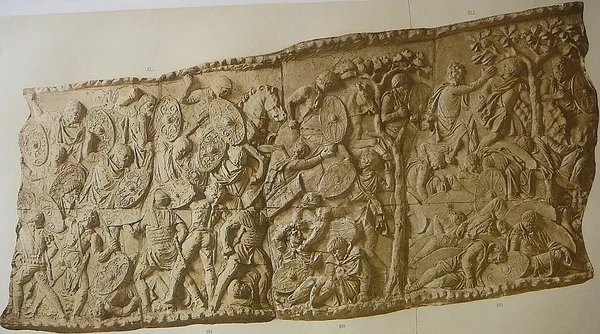
The 100s was a decade that ran from January 1, AD 100, to December 31, AD 109. During this period, the Roman Empire continued to expand its territory. Emperor Trajan, who ruled from 98 to 117 AD, launched several successful military campaigns, including the Dacian wars (101–106) and the possibly violent conquest of Nabataea (106). The conquest of Dacia in 106 secured its rich gold mines, and it is estimated that Dacia then contributed 700 million Denarii per annum to the Roman economy, providing finance for Rome's future campaigns and assisting with the rapid expansion of Roman towns throughout Europe. Furthermore, the conquest changed the balance of power in the region, leading to a renewed anti-Roman alliance of local Germanic and Celtic tribes. However, within the annexed territory and surrounds, the material advantages of being part of the Roman system were not lost on the majority of the surviving Dacian aristocracy. Thus began the process by which most modern Romanian historians and linguists believe that many of the Dacians subsequently became romanized (see Origin of Romanians). Alimenta, a Roman welfare program that had been initiated by Nerva in 98, continued to be in operation during this decade. In East Asia, the Han dynasty saw a succession of rulers: Emperor He was succeeded by Emperor Shang in 106, who was succeeded by Emperor An that same year. However, the young emperor An did not rule in his own right, with Deng Sui instead being regent from 106 onwards. Deng Sui showed herself to be an able regent who did not tolerate corruption, even by her own family members. She also carried out criminal law reforms. For example, in 107, she issued an edict that extended the period for death penalty appeals. She cut the expenses of the royal court, like the making of expensive handicrafts such as jade and ivory carvings, and sent home palace attendants with superfluous functions. She also demanded less tribute from the provinces. While Empress, she twice opened the imperial granaries to feed the hungry; forced the reduction of income landlords received from the land they rented out; she repaired waterways and cut court rituals and banquets. She also saw rebellions from the South Xiongnu and Qiang, the latter of which would not be quelled until the next decade. In West Asia, Parthia saw a revolt by Osroes I against Pacorus II in 109.
Also on this shelf
Imperialism.
Korean art.
See also
Uncatalogued shelfText from Wikipedia; plate via Wikimedia Commons. Text CC BY-SA 4.0; plate freely licensed (see Commons). Source record. Images and catalogue data are reproduced from open-access collections.