Asian Art
Chakravarti (Sanskrit term)
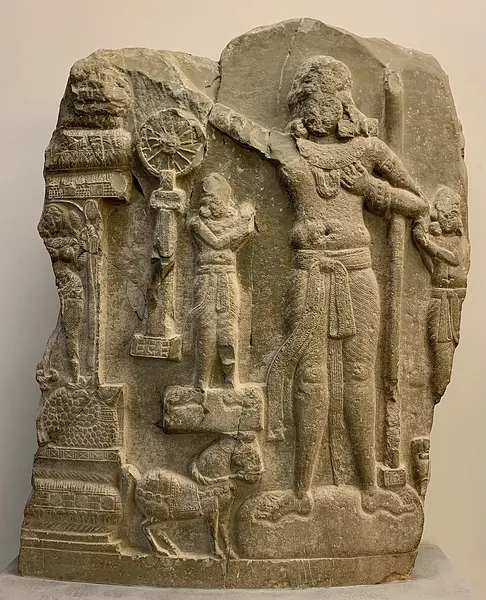
A chakravarti (Sanskrit: चक्रवर्तिन्, IAST: Cakravartin) is an ideal (or idealized) universal ruler in the historiography and religion of India. The concept is present in Indian subcontinent cultural traditions, narrative myths, and lore. There are three types of chakravarti: chakravala chakravarti, an emperor who rules over all four of the continents (i.e., a universal monarch); dvipa chakravarti, a ruler who governs only one of those continents; and pradesha chakravarti, a monarch who leads the people of only a part of a continent, the equivalent of a local king. Dvipa chakravarti is particularly one who rules the entire Indian subcontinent (as in the case of the Mauryan Empire). The concept of Chakravartin may have developed by the time of the early Maurya kings, in the 4th to 3rd century BCE, such as Emperor Ashoka, and it is mentioned in the Arthashastra (formerly considered to be a Maurya-period text but now re-dated as later). The word cakra-vartin- is a bahuvrīhi compound word, translating to "one who moves the wheels", in the sense of "whose chariot is rolling everywhere without obstruction". It can also be analysed as an instrumental tatpuruṣa: "through whom the wheel is moving" in the meaning of "through whom the Dharmachakra ("Wheel of the Dharma) is turning" (most commonly used in Buddhism). The Tibetan equivalent ཁོར་ལོས་སྒྱུར་བའི་རྒྱལ་པོ་ (khor los sgyur ba'i rgyal po) translates to "monarch who controls by means of a wheel". In Buddhism, a chakravarti is the secular counterpart of a buddha. The term applies to temporal as well as spiritual emperorship and leadership, particularly in Buddhism and Jainism. In Hinduism, a chakravarti is a powerful ruler whose dominion extends to the entire earth. In both religions, the chakravarti is supposed to uphold dharma, indeed being "he who turns the wheel (of dharma)". The Indian concept of chakravarti later evolved into the concept of devaraja – the divinity of kings – which was adopted by the Indianised Hindu-Buddhist kingdoms of Southeast Asia through Hindu Brahmin scholars deployed from India to their courts. It was first adopted by Javanese Hindu-Buddhist empires such as Majapahit; through them by the Khmer Empire; and subsequently by the Thai monarchs.
Also on this shelf
Hakuji.
Chinese herbology.
See also
Uncatalogued shelfText from Wikipedia; plate via Wikimedia Commons. Text CC BY-SA 4.0; plate freely licensed (see Commons). Source record. Images and catalogue data are reproduced from open-access collections.