Asian Art
History of the Forbidden City
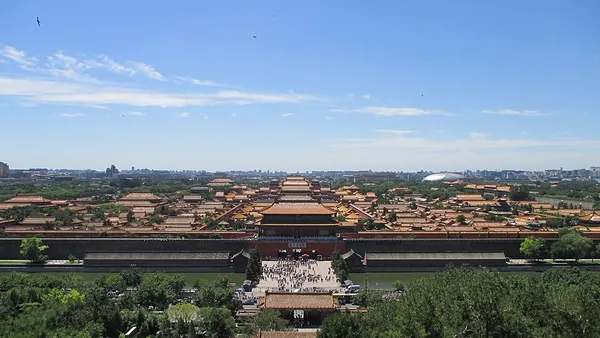
The Forbidden City was first built in the early-15th century as the palace of the Ming emperors of China. It is located in the centre of Beijing, China, and was the Chinese imperial palace from the early-Ming dynasty in 1420 to the end of the Qing dynasty in 1912, continuing to be home of the last emperor, Puyi, until 1924, since then it has been a museum. Built from 1406 to 1420, the palace complex has undergone many changes. After serving as the imperial palace for some five hundred years, the Forbidden City became a museum, the Palace Museum, in 1925. In 1987, it was declared a World Heritage Site by UNESCO.
Also on this shelf
Buddhism in Central Asia.
History of the Jews in Liberia.
See also
Uncatalogued shelfText from Wikipedia; plate via Wikimedia Commons. Text CC BY-SA 4.0; plate freely licensed (see Commons). Source record. Images and catalogue data are reproduced from open-access collections.