Asian Art
Cash coins in feng shui
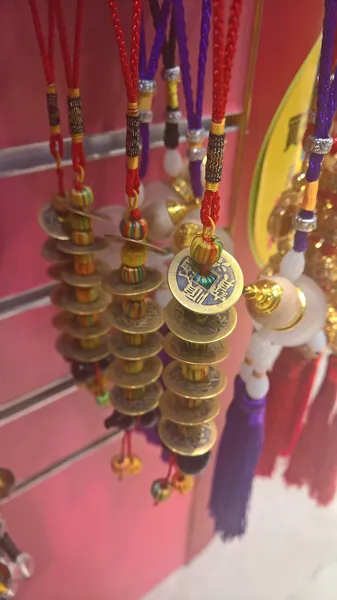
The usage of cash coins in the Chinese religious practice of feng shui is commonplace influencing many superstitions involving them. Believers in feng shui believe in a primal life force called qi (or chi) and apply their beliefs to the design of residential houses, as well as to commercial and public buildings, sometimes incorporating cash coins into the flow of this qi. Cash coins are category of ancient Chinese coinage which are typically round in shape and have a square central hole, these coins were used as the main currency of imperial China between 221 BC and 1912 AD. In feng shui cash coins are believed to be able to attract wealth and prosperity and to ward off "evil spirits" (煞氣; shà qì). However, placing them an outward facing position is believed to cause misfortune and placing them at the wrong places supposedly attracts "evil spirits" and poverty. For this reason special care is usually taken by feng shui practitioners when handling cash coins. While classic Chinese coins can come in a huge variety, particular categories of them enjoy more celebrity status than others, this is because Feng shui practitioners believe that some cash coin inscriptions are more auspicious than others, for example the Qianlong Tongbao (乾隆通寶) is commonly seen as an auspicious inscription because it was produced in a period of military and economic ascendancy in Chinese history, while the Xuanhe Tongbao (宣和通寶) is seen as inauspicious because it was produced during a more tumultuous era. Feng shui practitioners typically place cash coins that are strung together somewhere in their house or in a cash register to supposedly attract wealth, alternatively they may carry them around as an accessory or place them in their wallet for good luck. A common way cash coins are used in feng shui is as a set of 5 coins known as the "Five Emperor Coins" (see below), these are often used as counters to hanging beams or exposed pillars. When used for such purposes, the 5 coins are often tied together with a red string (as red is seen as an auspicious colour) so as to charge them with yang energy.
Also on this shelf
Imperial City of Huế.
Four occupations.
See also
Uncatalogued shelfText from Wikipedia; plate via Wikimedia Commons. Text CC BY-SA 4.0; plate freely licensed (see Commons). Source record. Images and catalogue data are reproduced from open-access collections.