Asian Art
Durga
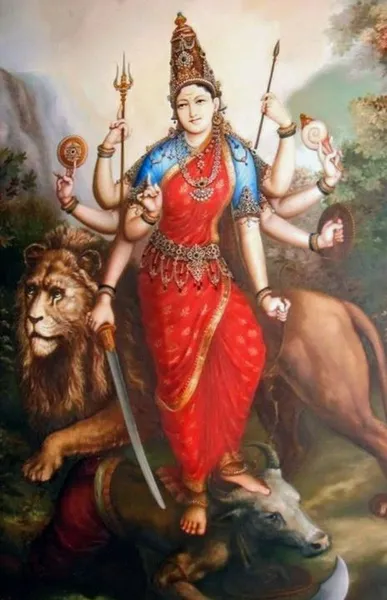
Durga (; Sanskrit: दुर्गा, lit. 'The Inaccessible One, The Impenetrable One', IAST: Durgā [d̪urɡaː]) is one of the most important deities in Hinduism. She is widely worshipped by the followers of the goddess-centric sect, Shaktism, regarded as the principal aspect of Mahadevi, the Ultimate Reality in this sect. Durga has importance in other denominations like Shaivism and Vaishnavism. She is associated with protection, strength, motherhood, destruction, and wars; her legends center around combating evils and demonic forces that threaten peace, dharma and cosmic order, representing the power of good over evil. Durga is seen as a motherly figure and often depicted as a warrior, riding a lion or tiger, with many arms, each carrying a weapon and defeating demons. Durga is believed to have originated as an ancient goddess worshipped by indigenous mountain-dwellers of the Indian subcontinent, before being established in the main Hindu pantheon by the 4th century CE. The most important texts of Shaktism, Devi Mahatmya and Devi Bhagavata Purana, which revere Devi (the Goddess) as the primordial creator of the universe, the Brahman (ultimate truth and reality), and identify Durga as the embodiment of creation, preservation, destruction, maya (illusion), shakti (power or energy) and prakriti (nature). She is best known as Mahishasura-mardini; for slaying Mahishasura—the buffalo demon. In accounts of her battles with other demons such as Shumbha and Nishumbha, Durga manifests other warrior goddesses, the Matrikas, and Kali, to aid in combat. In Vaishnava contexts, Durga is revered as Yoganidrā, the divine slumber, younger sister and a female version of Vishnu. Durga is typically portrayed as a celibate warrior goddess. However, at a certain point in her history, she becomes associated with the god Śiva as his wife. In this role, Durgā assumes domestic characteristics and is often identified with the goddess Parvati. She also takes on the role of mother in her later history. This identification is especially prominent in the regional traditions of Bengal, where Durga is also considered as the mother of the deities Ganesha, Kartikeya, Lakshmi, and Sarasvati. Durga has a significant following all over Nepal, India, Bangladesh and many other countries.
Also on this shelf
Buddhist art.
Gimcheon.
See also
Uncatalogued shelfText from Wikipedia; plate via Wikimedia Commons. Text CC BY-SA 4.0; plate freely licensed (see Commons). Source record. Images and catalogue data are reproduced from open-access collections.