Asian Art
Hongwu Emperor
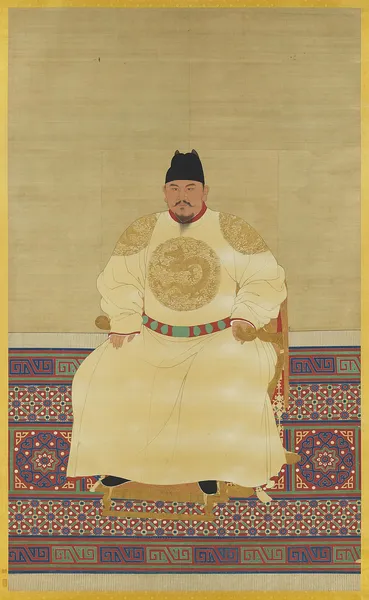
The Hongwu Emperor (21 October 1328 – 24 June 1398), personal name Zhu Yuanzhang, was the founding emperor of the Ming dynasty of China, reigning from 1368 to 1398. Born in 1328 into a peasant family in Anhui, Zhu Yuanzhang grew up during a period of epidemics, famines, and widespread uprisings in China under the Mongol-led Yuan dynasty. When he was 16, his parents and brother died in an epidemic. The orphaned Zhu briefly lived as a novice monk, begging for alms and gaining insight into the hardships of the common people. He also developed a dislike for book-dependent scholars. In 1352, he joined the Red Turban rebels, a movement that sought to overthrow Yuan rule, and quickly rose to command his own army. He captured Nanjing in 1356 and built a powerful regional regime in southern China. He adopted Yuan administrative practices and applied them to his expanding territory. Although he nominally acknowledged the authority of the Red Turban figurehead Han Lin'er, Zhu increasingly acted independently and, after defeating rival rebels, declared himself King of Wu in 1364. After successfully dominating southern and central China in early 1368, Zhu decided to rename the Kingdom of Wu to Da Ming, which translates to 'Great Radiance'. He adopted Hongwu, meaning 'Vastly Martial', as his era name. In the following four-year war, he drove out the Mongol forces loyal to the Yuan dynasty and unified the country, but failed to conquer Mongolia. During the Hongwu Emperor's 30-year reign, Ming China experienced significant growth and recovered from the effects of prolonged wars. The Emperor had a strong understanding of the structure of society and believed in implementing reforms to improve institutions. This approach differed from the Confucian belief that the ruler's moral example was the most important factor. The Hongwu Emperor also prioritized the safety of his people and the loyalty of his subordinates, demonstrating pragmatism and caution in military affairs. He maintained a disciplined army and made efforts to minimize the impact of war on civilians. He died in 1398 and was succeeded by his grandson, the Jianwen Emperor. In 1402, the Hongwu Emperor's fourth son, Zhu Di, overthrew the Jianwen Emperor following a civil war and took the throne as the Yongle Emperor.
Also on this shelf
History of manga.
Empire of Japan.
See also
Uncatalogued shelfText from Wikipedia; plate via Wikimedia Commons. Text CC BY-SA 4.0; plate freely licensed (see Commons). Source record. Images and catalogue data are reproduced from open-access collections.