Asian Art
Hainan people
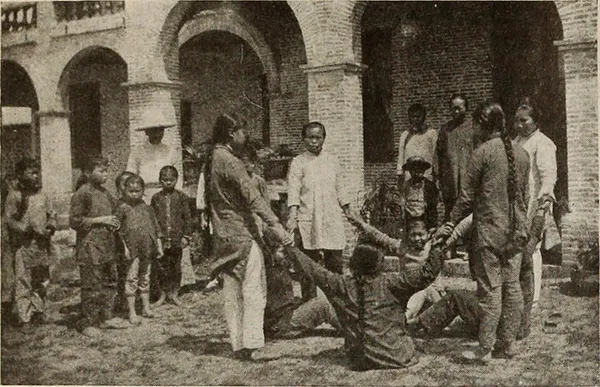
Hainan people, also called Hainam people (Chinese: 海南人 or 海南儂; HTS: Hhai3nam2nang2; BOT: Hái-nâm-nâng) or Hainanese people, are the residents of Hainan, China's southernmost and smallest province. The term Hainanese can refer to all residents of the island or, more specifically, to the Min-speaking Han Chinese sub-ethnic group native to the area. Hainan Min speakers often refer to their native language as Qiongwen or Qiongzhou to distinguish themselves from other groups of Hainan such as the Cantonese, Tanka, Hlai, and Miao. Han Hainanese people, who today form the majority population of the island, trace their origins to Han colonists and exiles from Fujian and Guangdong provinces. By and large, they were not voluntary colonists, but were acting on government orders to populate the sparsely populated peninsula and island. By contrast, the Lingaoese, Hlai, and Tanka migrated to the island much earlier and are regarded as part of the Nanyue or Baiyue peoples. Beginning in the Song dynasty, Han colonists from northeastern Fujian started settling on the Leizhou Peninsula and Hainan island. This displaced indigenous Nanyue groups, such as the Hlai, who then moved into mountain areas. In the main, genetic studies based on Haikou Han samples show that Hainanese Han cluster most closely with Chinese Singaporeans and Han Taiwanese. However, other studies suggest that Hainanese genetically cluster most closely with Guangxi and Guangdong Han Chinese. Like Fujian and Guangdong provinces, Hainan has been a source for emigration. Towards the turn of the 20th century, many Hainanese migrated to various Southeast Asian nations, where they worked as cooks, restaurateurs, coffee shop owners, clothes makers, sailors and hoteliers, filling niches left unoccupied by previous groups of immigrants from China. The Hainanese were particularly successful in Thailand, there are 2 million Hainanese in Thailand. as well as large number of tycoons trace Hainanese origin, and in Cambodia, where they controlled the hotel and restaurant trade. They also formed a substantial proportion of Chinese communities in Vietnam, Indonesia, Laos, Singapore and Malaysia. The outbreak of war with Japan prompted the departures of 33,000 persons in 1936 and 44,000 in 1937 from Hainan. Overseas Hainanese have been a significant and particularly active source of remittances to China.
Also on this shelf
6th Dalai Lama.
Granary.
See also
Uncatalogued shelfText from Wikipedia; plate via Wikimedia Commons. Text CC BY-SA 4.0; plate freely licensed (see Commons). Source record. Images and catalogue data are reproduced from open-access collections.