Asian Art
Haskalah
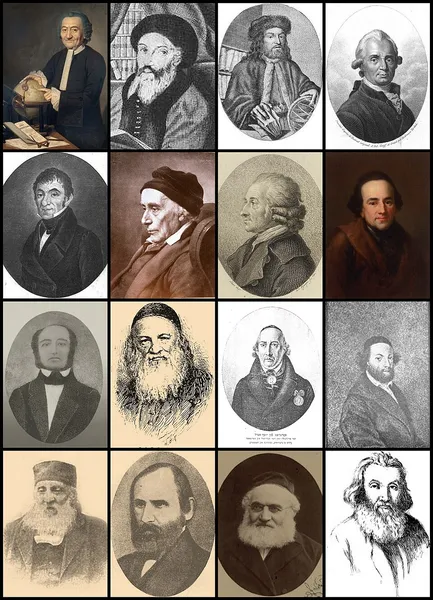
The Haskalah (Hebrew: הַשְׂכָּלָה, literally, "wisdom", "erudition" or "education"), often termed the Jewish Enlightenment, was an intellectual movement among the Jews of Central and Eastern Europe, with a certain influence on those in Western Europe. It arose as a defined ideological worldview during the 1770s, and its last stage ended around 1881–82, when the pogroms in the Russian Empire contributed to a shift among many of its proponents, known as maskilim, toward Jewish nationalism. The movement advocated against Jewish parochialism and encouraged the adoption of prevailing attire over traditional dress, while also working to diminish the authority of traditional community institutions such as rabbinic courts and boards of elders. It pursued a set of projects of cultural and moral renewal, including a revival of Hebrew for use in secular life, which resulted in an increase in Hebrew found in print. Concurrently, it strove for an optimal integration in surrounding societies. Practitioners promoted the study of exogenous culture, style and language as well as the adoption of modern values. At the same time, economic production, and the taking up of new occupations was pursued. The Haskalah promoted rationalism, romanticism, liberalism, and enquiry, and is largely perceived as the Jewish variant of the general Age of Enlightenment. The movement encompassed a wide spectrum ranging from moderates, who hoped for maximal compromise, to radicals, who sought sweeping changes. In its various changes, the Haskalah fulfilled an important, though limited, part in the modernization of Central and Eastern European Jews. Its activists, the Maskilim, exhorted and implemented communal, educational and cultural reforms in both the public and the private spheres. Owing to its dual policies, it collided both with the traditionalist rabbinic elite, which attempted to preserve old Jewish values and norms in their entirety, and with the radical assimilationists who wished to eliminate or minimize the existence of the Jews as a defined collective.
Also on this shelf
Bahmani Kingdom.
Card game.
See also
Uncatalogued shelfText from Wikipedia; plate via Wikimedia Commons. Text CC BY-SA 4.0; plate freely licensed (see Commons). Source record. Images and catalogue data are reproduced from open-access collections.