Asian Art
Golden Light Sutra
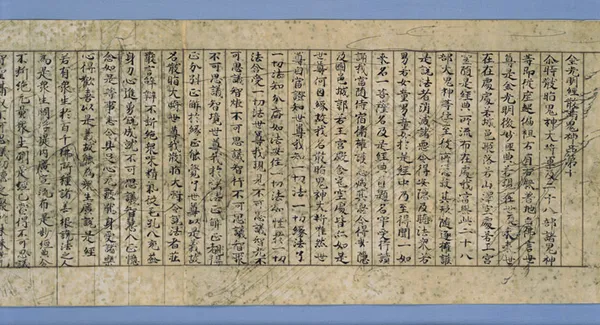
The Golden Light Sutra (Sanskrit: Suvarṇaprabhāsottamasūtra, lit. Sublime Golden Light Sutra; Chinese: 金光明經, Jin guangming jing) is a Mahayana Buddhist scripture, which has been important as an apotropaic and purificatory text. A significant portion of the sutra is directed at monarchs or involves supernatural protection and it has thus been an important source for Buddhist states and rulers who wish to protect themselves and their nations. The title of the sutra comes from the central fourth chapter, in which a lay bodhisattva named Ruciraketu sees a shining golden drum in a dream. The drum emanates light and a hundred-verse prayer to the Buddha when beaten. Much of the subsequent sutra teaches the recitation of this prayer along with devotion to the Golden Light Sutra itself. Self-referential discussion of the powers of the Golden Light Sutra is another key theme of the text, which also calls itself the "king of kings of sūtras". The Golden Light also contains a key chapter on repentance, which is a central practice in East Asian Buddhism. Divine protection is yet another key teaching of the text, which explains how numerous divine beings, including the Four Heavenly Kings, the goddess of the earth, Sarasvatī, and Śrī, will protect those who recite the prayer and the sutra. The sutra also emphasizes that kings who support and honor the recitation of the Golden Light Sutra will have a prosperous and peaceful kingdom, free of invasions, disasters and famine. Due to these purported benefits, the Golden Light became an influential ritual text in Mahayana Buddhism, especially in East Asia where it had a key ceremonial role in state protection ceremonies. It is still recited in East Asian Buddhism and in Tibetan Buddhism for its protective and pacifying effects.
Also on this shelf
Baghdad.
Chinese herbology.
See also
Uncatalogued shelfText from Wikipedia; plate via Wikimedia Commons. Text CC BY-SA 4.0; plate freely licensed (see Commons). Source record. Images and catalogue data are reproduced from open-access collections.