Asian Art
Gujarat Sultanate
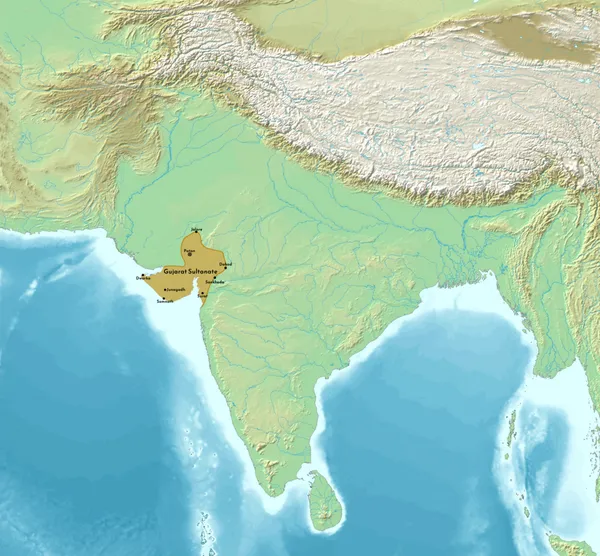
The Gujarat Sultanate or Sultanate of Gujarat was a late medieval Indian state in Western India, primarily based in the present-day state of Gujarat. The kingdom was established in 1394 when Muzaffar Shah I, the governor of Gujarat, declared independence from the Tughlaq dynasty of Delhi. Following Timur's invasion of the Delhi Sultanate, Delhi was devastated and its rule weakened considerably, leading Muzaffar Shah to declare himself independent in 1394, and formally established the Sultanate in Gujarat. The next sultan, his grandson Ahmad Shah I, moved the capital to Ahmedabad in 1411. His successor Muhammad Shah II subdued most Rajput chieftains. The prosperity of the sultanate reached its zenith during the rule of Mahmud Begada. He also subdued most Gujarati Rajput chieftains and built a navy off the coast of Diu. The greatest territorial extent was achieved under Bahadur Shah. In 1509, the Portuguese Empire wrested Diu from the Sultanate in the Battle of Diu. The Mughal emperor Humayun attacked Gujarat in 1535 and briefly occupied it, during which Bombay, Bassein and Daman would become a Portuguese colony, thereafter Bahadur Shah was killed by the Portuguese while making a deal in 1537. The end of the sultanate came in 1573, when Akbar annexed the Gujarat Sultanate into his empire. The last ruler, Muzaffar Shah III, was taken a prisoner to Agra. In 1583, he escaped from the prison, and with the help of the nobles, succeeded to regain the throne for a short period before being defeated by Akbar's minister Abdul Rahim Khan-i-Khanan.
Also on this shelf
Great Ming Treasure Note.
Lanzhou.
See also
Uncatalogued shelfText from Wikipedia; plate via Wikimedia Commons. Text CC BY-SA 4.0; plate freely licensed (see Commons). Source record. Images and catalogue data are reproduced from open-access collections.