Asian Art
Coromandel lacquer
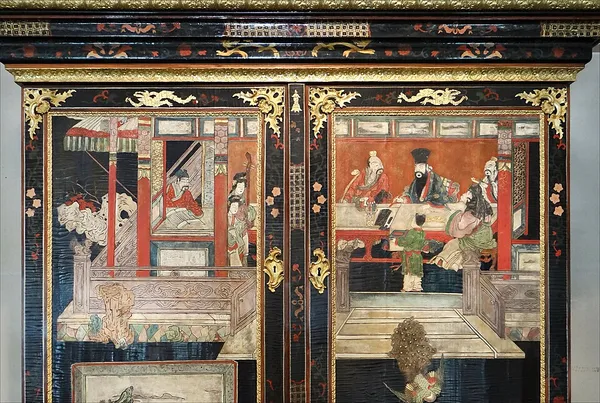
Coromandel lacquer is a type of Chinese lacquerware, latterly mainly made for export, so called only in the West because it was shipped to European markets via the Coromandel coast of south-east India, where the Dutch East Indies Company (VOC) and its rivals from a number of European powers had bases in the 18th century. The most common type of object made in the style, both for Chinese domestic use and exports was the Coromandel screen, a large folding screen with as many as twelve leaves, coated in black lacquer with large pictures using the kuan cai (款彩; literally "incised colors") technique, sometimes combined with mother of pearl inlays. Other pieces made include chests and panels. But in Europe cabinet-makers often cut the screens into a number of panels, which were inserted into pieces of furniture made locally in the usual European shapes of the day, or mounted within wood panelling on walls. This was often also done with Japanese lacquer in rather different techniques, but "Coromandel" should only be used to refer to Chinese lacquer. The peak of the fashion for panelling rooms was the late 17th century. By the 18th century, Chinese wallpaper began to reach Europe, and generally replaced lacquer panels as a cover for walls. At the time of the first imports in the 17th century, Coromandel lacquer was known in English as "Bantam ware" or "Bantam work" after the VOC port of Bantam on Java, modern Bantem, Indonesia. The first recorded use of "Coromandel lacquer" is in French, from a Parisian auction catalogue of 1782.
Also on this shelf
Hohhot.
Art Institute of Chicago.
See also
Uncatalogued shelfText from Wikipedia; plate via Wikimedia Commons. Text CC BY-SA 4.0; plate freely licensed (see Commons). Source record. Images and catalogue data are reproduced from open-access collections.