Asian Art
Economy of the Ming dynasty
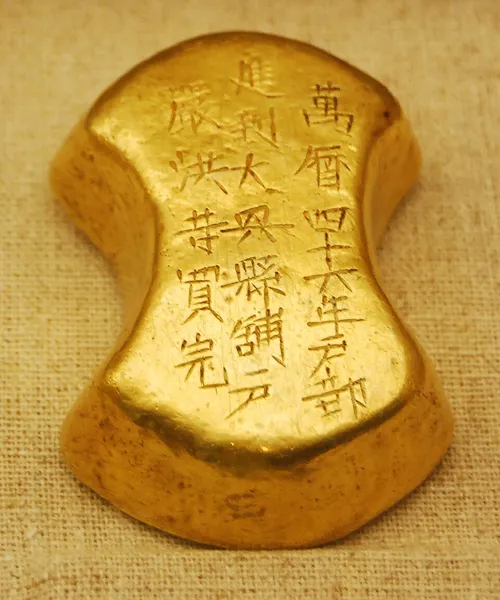
The economy of the Ming dynasty (1368–1644) was the largest in the world at the time, with China's share of the world's gross domestic product estimated at 31%, and other estimates at 25% by 1500 and 29% by 1600. The Ming era is considered one of the three golden ages of China, alongside the Han and Tang dynasties. The founder of the Ming dynasty, the Hongwu Emperor, aimed to create a more equal society with self-sufficient peasant farms, supplemented by necessary artisans and merchants in the cities. The state was responsible for distributing surpluses and investing in infrastructure. To achieve this goal, the state administration was reestablished and tax inventories of the population and land were conducted. Taxes were lowered from the high levels imposed during the Mongol-led Yuan dynasty. The government's support for agricultural production and reconstruction of the country resulted in surpluses, which were then traded in markets. This also led to the emergence of property differentiation and the growing political influence of large landowners (gentry) and merchants, ultimately weakening the power of the government. During the middle Ming period, there was a gradual relaxation of state control over the economy. This was evident in the government's decision to abolish state monopolies on the production of salt and iron, and to privatize these and other industries such as textiles, porcelain, and paper mills. This led to the establishment of numerous private enterprises, some of which were quite large and employed hundreds of workers who were paid wages. In the agricultural sector, there was a growing trend of farms specializing in crops for the market, with different regions focusing on different crops. This also led to the expansion of market-oriented enterprises that grew crops such as tea, fruit, and industrial crops like lacquerware and cotton on a large scale. This regional specialization in agriculture continued into the Qing dynasty. Additionally, there was a shift from paying taxes in the form of products and labor obligations at the beginning of the dynasty to paying them in monetary form over time. In addition to internal trade, foreign trade also flourished during the Ming era, but it was heavily regulated by the government in the first two centuries.
Also on this shelf
Japanese mythology.
Empire of Brazil.
See also
Uncatalogued shelfText from Wikipedia; plate via Wikimedia Commons. Text CC BY-SA 4.0; plate freely licensed (see Commons). Source record. Images and catalogue data are reproduced from open-access collections.