Asian Art
Duke Yansheng
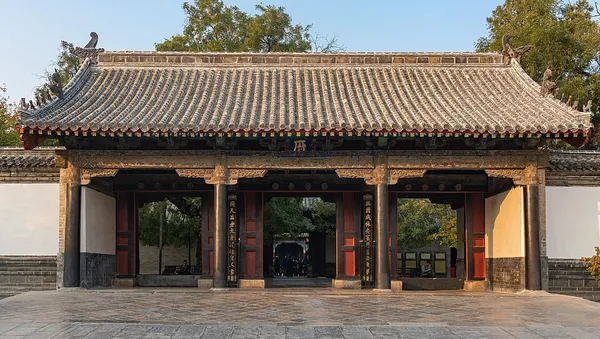
The Duke Yansheng, literally "Honorable Overflowing with Wisdom", sometimes translated as Holy Duke of Yen, was a Chinese title of nobility. It was originally created as a marquis title in the Western Han dynasty for a direct descendant of Confucius. From the Western Han dynasty to the mid-Northern Song dynasty, the title underwent several changes in its name, before it was finally settled as "Duke Yansheng" in 1005 by Emperor Renzong of the Northern Song dynasty. Kong Zongyuan, a 46th-generation descendant of Confucius, became the first person to hold the title "Duke Yansheng". The dukes enjoyed privileges that other nobles were denied, such as the right to tax their domain in Qufu while being exempt from imperial taxes. Their dukedom had its own judicial system and the legal capacity to mete out capital punishment, although such sentences had to be ratified by the imperial court. In 1935, the Nationalist government of the Republic of China converted the Duke Yansheng title to a political office, "Dacheng Zhisheng Xianshi Fengsi Guan" (大成至聖先師奉祀官), which simply means "Ceremonial Official to Confucius". This political office is not only hereditary, but also had the same ranking and remuneration as that of a cabinet minister in the government of the Republic of China. In 2008, with permission from the Kong family, the political office became an unpaid one which is purely ceremonial in nature. It is currently held by Kung Tsui-chang, a 79th-generation descendant of Confucius. There are also similar political offices for the descendants of the other notable members of the Confucian school (the Four Sages), such as "Ceremonial Official to Mencius", "Ceremonial Official to Zengzi", and "Ceremonial Official to Yan Hui". In the reformation of the law in 2009, "Ceremonial Official to Mencius" and "Ceremonial Official to Zengzi" would become unpaid honorable titles as well once the incumbent officials decease. The tombs of the Dukes Yansheng of the Ming and Qing dynasties are located at the Cemetery of Confucius in Qufu, Shandong.
Also on this shelf
British Museum Department of Asia.
Jurōjin.
See also
Uncatalogued shelfText from Wikipedia; plate via Wikimedia Commons. Text CC BY-SA 4.0; plate freely licensed (see Commons). Source record. Images and catalogue data are reproduced from open-access collections.