Asian Art
Champa
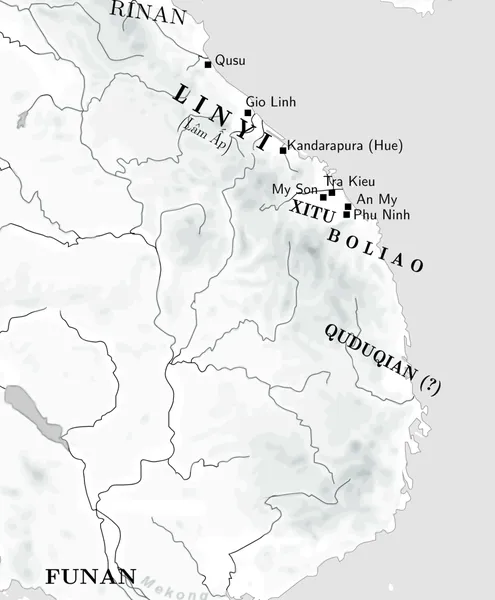
Champa was a collection of independent Cham polities that extended across the coast of what is present-day central and southern Vietnam from approximately 2nd century AD until 1832. According to the earliest historical references found in the ancient sources, the first Cham polities were established around the 2nd to 3rd centuries AD, in the wake of Khu Liên's rebellion against the rule of the Eastern Han dynasty, and lasted until when the final remaining principality of Champa was annexed by emperor Minh Mạng of the Nguyễn dynasty as a part of the expansionist Nam tiến policy. Early Champa evolved from the seafaring Austronesian Chamic Sa Huỳnh culture off the coast of modern-day Vietnam. It was preceded in the region by a kingdom called Lâm Ấp (Vietnamese), or Linyi (林邑, Middle Chinese (ZS): *liɪm ʔˠiɪp̚), that was in existence since 192 AD; although the historical relationship between Linyi and Champa is not clear. Scholarly consensus has shifted several times as to what degree Champa functioned as a unified polity. Originally being viewed as a unified kingdom throughout most of its history, later authors suggested that Champa was better considered to be a federation of independent states. A number of modern scholars have suggested that Champa did form a unified kingdom in some periods but was disunited in others. Hinduism, adopted through conflicts and conquest of territory from neighboring Funan in the 4th century AD, shaped the art and culture of the Cham Kingdom for centuries, as exemplified by the many Cham Hindu statues and red brick temples that dotted the landscape in Cham lands. In Champa, historians have also found the Đông Yên Châu inscription, the oldest known native Southeast Asian literature written in a native Southeast Asian language dating to around c. 350 AD, predating first Khmer, Mon, Malay texts by centuries. Champa reached its apogee in the 9th and 10th centuries CE. The peoples of Champa maintained a system of lucrative trade networks across the region, connecting the Indian Ocean and Eastern Asia, until the 17th century. Thereafter, it began a gradual decline under pressure from Đại Việt, the Vietnamese polity centered in the region of modern Hanoi. In 1832, the Vietnamese emperor Minh Mạng annexed the remaining Cham territories.
Also on this shelf
Burmese cuisine.
Hyderabad.
See also
Uncatalogued shelfText from Wikipedia; plate via Wikimedia Commons. Text CC BY-SA 4.0; plate freely licensed (see Commons). Source record. Images and catalogue data are reproduced from open-access collections.