Asian Art
Kyrgyz Khaganate
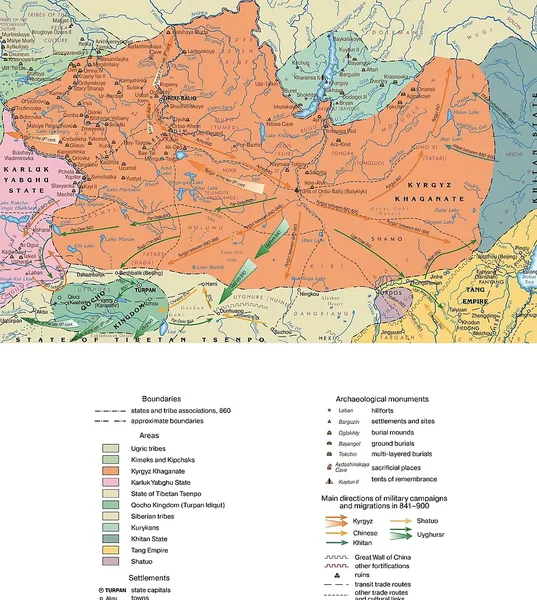
The Kyrgyz Khaganate (also Yenisei Kyrgyz Khaganate or Kirghiz Khaganate) was a Turkic khaganate centered in southern Siberia. After the defeat of the Uyghur Khaganate in the hands of the Kyrgyz in 840, they gained political prestige and, for a short period until the mid-10th century (c. 925), established a nominal supremacy on the steppe. Many scholars have assumed that the Kyrgyz extended their control over the Mongolian Plateau after 840. However, as Michael Drompp observes, the Kyrgyz remained in their Yenisei homelands and there is no evidence of a permanent migration to the Tian Shan or beyond. Peter Golden likewise emphasizes that their domination was nominal and military in character and that they did not establish a centralized empire like the Gökturks or Uyghurs. In another work, Golden stresses that their power was real enough to defeat the Uighurs, but they did not create a lasting empire. Their authority was limited to the Yenisei region. According to the Cambridge History of Early Inner Asia, their ascendancy did not translate into territorial expansion.
Also on this shelf
Architecture of Penang.
1689.
See also
Uncatalogued shelfText from Wikipedia; plate via Wikimedia Commons. Text CC BY-SA 4.0; plate freely licensed (see Commons). Source record. Images and catalogue data are reproduced from open-access collections.