Asian Art
Burmese cuisine
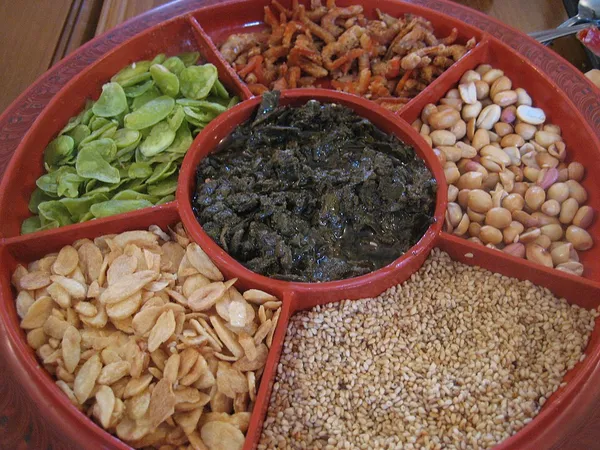
Burmese cuisine encompasses the diverse regional culinary traditions of Myanmar, which have developed through longstanding agricultural practices, centuries of sociopolitical and economic change, and cross-cultural contact and trade with neighboring countries at the confluence of Southeast Asia, East Asia, and South Asia, such as modern-day nations of Thailand, China, and India, respectively. Burmese cuisine is typified by a wide-ranging array of dishes, including traditional Burmese curries and stews, Burmese salads, accompanied by soups and a medley of vegetables that are traditionally eaten with white rice. Burmese curries are generally distinguished from other Southeast Asian curries in the former's prominent use of an aromatic trio of garlic, shallots, and ginger (in common with South Asian curries), and the general lack of coconut milk. Burmese cuisine also features Indian breads as well as noodles, which are fried or prepared in salads and noodle soups, chief among them mohinga. Street food and snack culture have also nurtured the profuse variety of traditional Burmese fritters and modern savory and sweet snacks labeled under the umbrella of mont. The contrasting flavor profile of Burmese cuisine is broadly captured in the phrase chin ngan sat (ချဉ်ငန်စပ်), which literally means "sour, salty, and spicy." A popular Burmese rhyme — "of all the fruit, the mango's the best; of all the meat, the pork's the best; and of all the vegetables, lahpet's (tea leaves are) the best" — sums up the traditional favourites.
Also on this shelf
History of American newspapers.
Art.
See also
Uncatalogued shelfText from Wikipedia; plate via Wikimedia Commons. Text CC BY-SA 4.0; plate freely licensed (see Commons). Source record. Images and catalogue data are reproduced from open-access collections.