Art of the Americas
Maya civilization
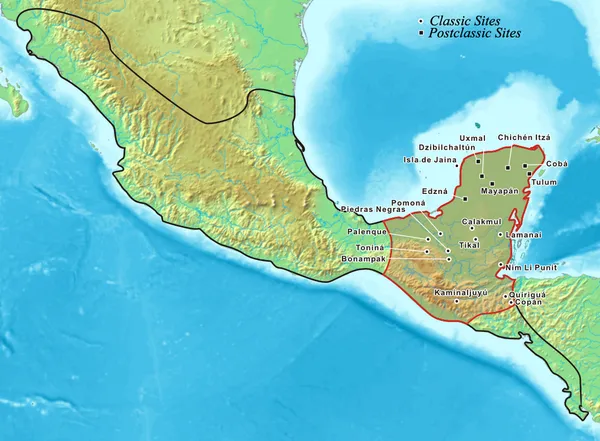
The Maya civilization () was a Mesoamerican civilization that existed from antiquity to the early modern period. Known by its ancient temples and glyphs (script), the civilization is also noted for its art, architecture, mathematics, calendar, and astronomical system. The Maya script is the most sophisticated and highly developed writing system in the pre-Columbian Americas. The Maya civilization developed in the Maya Region, an area that today comprises southeastern Mexico, all of Guatemala and Belize, and the western portions of Honduras and El Salvador. Today, their descendants, known collectively as the Maya, number well over 6 million individuals, speak more than twenty-eight surviving Mayan languages, and reside in nearly the same area. The Archaic period, before 2000 BC, saw the first developments in agriculture and the earliest villages. The Preclassic period (c. 2000 BC to 250 AD) saw the establishment of the first complex societies in the Maya region, and the cultivation of the staple crops of the Maya diet, including maize, beans, squashes, and chili peppers. The first Maya cities developed around 750 BC. Hieroglyphic writing was being used in the Maya region by the 3rd century BC. In the Late Preclassic, a number of large cities developed in the Petén Basin, and the city of Kaminaljuyu rose to prominence in the Guatemalan Highlands. Beginning around 250 AD, the Classic period is largely defined as when the Maya were raising sculpted monuments with Long Count dates. This period saw the Maya civilization develop many city-states linked by a complex trade network. In the Maya Lowlands two great rivals, the cities of Tikal and Calakmul, became powerful. The Classic period also saw the intrusive intervention of the central Mexican city of Teotihuacan in Maya dynastic politics. In the 9th century, there was a widespread political collapse in the central Maya region, resulting in civil wars, the abandonment of cities, and a northward shift of population. The Postclassic period saw the rise of Chichen Itza in the north, and the expansion of the aggressive Kʼicheʼ kingdom in the Guatemalan Highlands. In the 16th century, the Spanish Empire colonized the Mesoamerican region, and a lengthy series of campaigns saw the fall of Nojpetén, the last Maya city, in 1697.
Also on this shelf
La Otra Banda.
Classic stage.
See also
Uncatalogued shelfText from Wikipedia; plate via Wikimedia Commons. Text CC BY-SA 4.0; plate freely licensed (see Commons). Source record. Images and catalogue data are reproduced from open-access collections.