Art of the Americas
Axe-monies
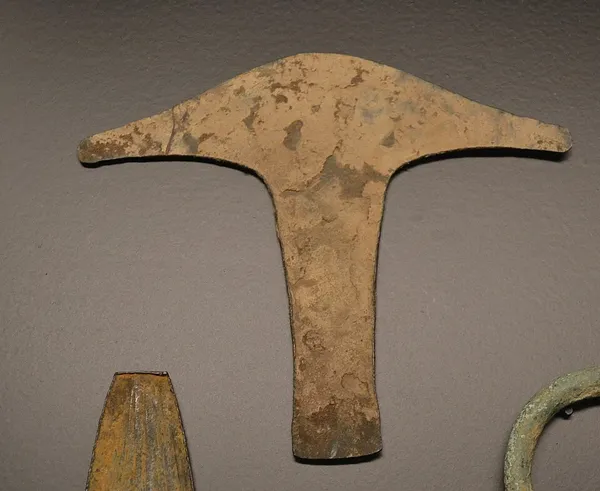
Axe-monies (Spanish: Tajaderos) refer to copper artifacts found in both western Mesoamerica and the northern Andes. Based on ethnohistorical, archaeological, chemical, and metallurgical analyses, the scholars Hosler, Lechtman and Holm have argued for their use in both regions (which are separated by thousands of miles) through trade. In contrast to naipes, bow-tie- or card-shaped metal objects which appear in the archaeological record only in the northern Andean coastal region, axe-monies are found in both Mesoamerican and Andean cultural zones. More specifically, it is argued that the system of money first arose on the north coast of Peru and Ecuador in the early second millennium CE. In both regions, copper was smelted, likely by family units, and hammered into thin, axe-shaped forms and bundled in multiples of five, usually twenty. As they are often found in burials, it is likely that in addition to their presumed economic use, they also had ceremonial value.
Also on this shelf
Beau Dick.
Indigenous cuisine of the Americas.
See also
Uncatalogued shelfText from Wikipedia; plate via Wikimedia Commons. Text CC BY-SA 4.0; plate freely licensed (see Commons). Source record. Images and catalogue data are reproduced from open-access collections.