Art of the Americas
Classic Veracruz culture
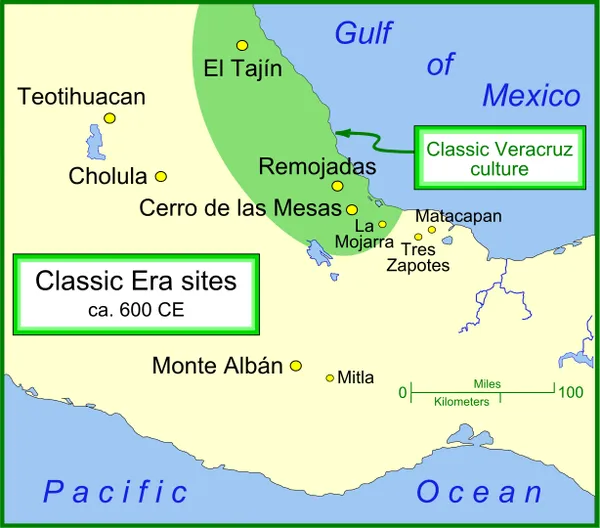
Classic Veracruz culture (or Gulf Coast Classic culture) refers to a cultural area in the north and central areas of the present-day Mexican state of Veracruz, a culture that existed from roughly 100 to 1000 CE, or during the Classic era. El Tajin was the major center of Classic Veracruz culture; other notable settlements include Higueras, Zapotal, Cerro de las Mesas, Nopiloa, and Remojadas, the latter two important ceramics centers. The culture spanned the Gulf Coast between the Pánuco River on the north and the Papaloapan River on the south. The Classic Veracruz culture is sometimes associated with the Totonacs, who were occupying this territory at the time of the Spanish Conquest of the Aztec Empire. However, there is little or no evidence that the Totonacs were the originators of the Classic era culture. Another candidate for the ethnolinguistic identity is the Huastecs.
Also on this shelf
Folk art.
Aztecs.
See also
Uncatalogued shelfText from Wikipedia; plate via Wikimedia Commons. Text CC BY-SA 4.0; plate freely licensed (see Commons). Source record. Images and catalogue data are reproduced from open-access collections.