Art of the Americas
Chimor
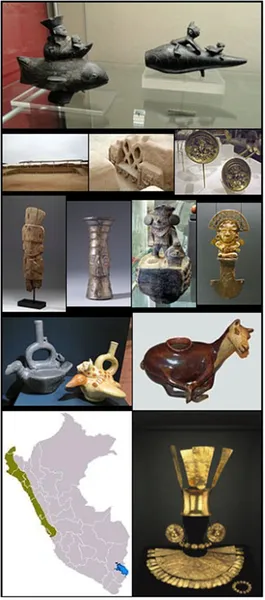
Chimor (also Kingdom of Chimor or Chimú Empire) was the political grouping of the Chimú culture (Spanish pronunciation: [tʃiˈmu]). The culture arose about 900 CE, succeeding the Moche culture, and was later conquered by the Inca emperor Topa Inca Yupanqui around 1470, fifty years before the arrival of the Spanish in the region. Chimor was the largest kingdom in the Late Intermediate Period, encompassing 1,000 kilometres (620 mi) of modern-day Peruvian coastline. According to Chimú oral history, the history of Chimor began with the arrival of Taycanamo in the Moche Valley from the sea on a balsa raft. From there, his descendants would conquer surrounding areas starting with his son Guacricur. Guacricur integrated Chimú's reign over the lower valley and Ñancempinco, Taycanamo's grandson, would expand the kingdom by conquering the upper valley. Ñançenpinco began further expansion both north and south of the Moche Valleys. The first valleys seem to have joined forces willingly, but the Sican culture was acquired through conquest. They also were significantly influenced by the pre-Inca Cajamarca and Wari cultures. According to legend, its capital of Chan Chan was founded by Taycanamo. Chimor was the last kingdom that had any chance of stopping the Inca Empire. But the Inca conquest began in the 1470s by Topa Inca Yupanqui, defeating the emperor and descendant of Taycanamo, Minchançaman, and was nearly complete when Huayna Capac assumed the throne in 1493. The Chimú resided on a strip of desert on the northern coast of Peru. The rivers in the region carved a series of fertile valley plains, which were very flat and well-suited to irrigation. Agriculture and fishing were both very important to the Chimú economy. The Chimú worshipped the Moon, and unlike the Inca considered it more powerful than the sun. Offerings played an important role in religious rites. A common object for offerings, as well as one used by artisans, was the shell of the Spondylus shellfish, which resides only in the warm coastal waters off present-day Ecuador.
Also on this shelf
Diaguita.
Acolhua.
See also
Uncatalogued shelfText from Wikipedia; plate via Wikimedia Commons. Text CC BY-SA 4.0; plate freely licensed (see Commons). Source record. Images and catalogue data are reproduced from open-access collections.