Art of the Americas
Latin America
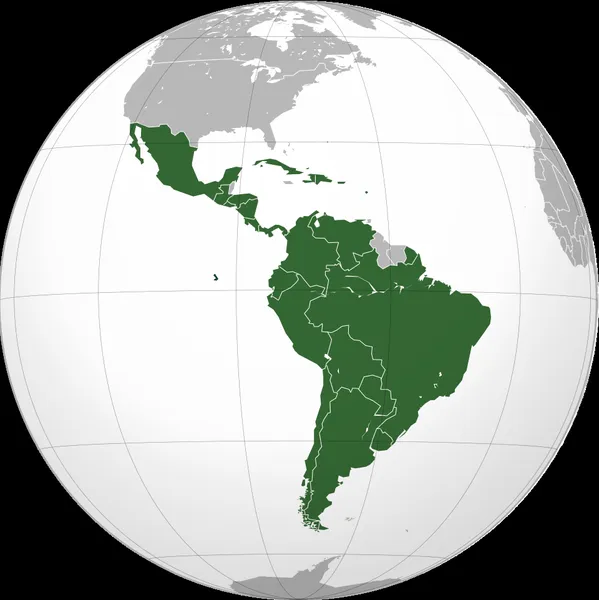
Latin America (Spanish: América Latina or Latinoamérica; Portuguese: América Latina) is the cultural region of the Americas where Romance languages are predominantly spoken, primarily Spanish and Portuguese. Since it is defined according to its cultural identity instead of its geography, Latin America includes countries from both North and South America. For instance, countries from North America like Mexico, Honduras, Guatemala, etc. tend to be included. In fact, most of the countries in Central America, South America and the Caribbean are considered Latin American countries. English or Dutch-speaking countries in South America or the Caribbean like Belize, Guyana, Jamaica, Trinidad and Tobago, Suriname, etc. are not considered "Latin American" because they speak Germanic languages. As such, Latin America comprises Hispanic America along with Brazil. Related terms include the narrower Hispanic America, which exclusively refers to Spanish-speaking nations; and the broader Ibero-America, which includes all Iberian countries in the Americas. The term Latin America was first introduced in 1856 at a conference named Initiative of the Americas: Idea for a Federal Congress of the Republics (Iniciativa de la América. Idea de un Congreso Federal de las Repúblicas), at Paris. Chilean politician Francisco Bilbao coined the term to refer to countries sharing cultural and linguistic heritage. It gained further prominence during the 1860s under the rule of Napoleon III, whose government sought to justify France's intervention in the Second Mexican Empire.
Also on this shelf
Aztecs.
Lithic period in Mesoamerica.
See also
Uncatalogued shelfText from Wikipedia; plate via Wikimedia Commons. Text CC BY-SA 4.0; plate freely licensed (see Commons). Source record. Images and catalogue data are reproduced from open-access collections.