Art of the Americas
Jicarilla Apache
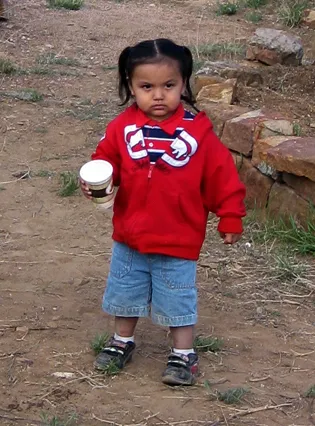
Jicarilla Apache (Spanish: [xikaˈɾiʝa], locally [hɪkəˈɹiə]; Jicarilla Apache: Jicarilla Dindéi), one of several loosely organized autonomous bands of the Eastern Apache, refers to the members of the Jicarilla Apache Nation currently living in New Mexico and speaking a Southern Athabaskan language. The term jicarilla comes from Mexican Spanish meaning "little basket", referring to the small sealed baskets they used as drinking vessels. To neighboring Apache bands, such as the Mescalero and Lipan, they were known as Kinya-Inde ("People who live in fixed houses"). The Jicarilla called themselves also Haisndayin, translated as "people who came from below" because they believed themselves to be the sole descendants of the first people to emerge from the underworld. The underworld was the home of Ancestral Man and Ancestral Woman, who produced the first people. The Jicarilla believed Hascin, their chief deity, created Ancestral Man and Ancestral Woman, as well as all the animals, the sun, and the moon. The Jicarilla Apache led a seminomadic existence in the Sangre de Cristo Mountains and the plains of southern Colorado and northern New Mexico. They also ranged into the Great Plains starting before 1525 CE. For years, they lived a relatively peaceful life, traveling seasonally to traditional sites for hunting, gathering, and cultivation along river beds. The Jicarilla learned about farming and pottery from the Puebloan peoples and about survival on the plains from the Plains Indians. Their diet and lifestyle were rich and varied. The Jicarilla's farming practices expanded to the point where they required considerable time and energy. As a result, the people became rather firmly settled and tended to engage in warfare less frequently than other Eastern Apache groups. Starting in the 1700s, the Jicarilla experienced encroachment by colonial New Spain, pressure from other Native American tribes such as the Comanches, and subsequent westward expansion of the United States. These factors led to significant loss of property, expulsion from their sacred lands, and relocation to lands unsuited for survival. The mid-1800s to the mid-1900s were particularly difficult for the Jicarilla. Their tribal bands were displaced, treaties were made and broken with them, and they experienced a significant loss of life due to tuberculosis and other diseases.
Also on this shelf
Murray River.
Actopan, Hidalgo.
See also
Uncatalogued shelfText from Wikipedia; plate via Wikimedia Commons. Text CC BY-SA 4.0; plate freely licensed (see Commons). Source record. Images and catalogue data are reproduced from open-access collections.