Arms and Armour
Battle of Roncevaux Pass
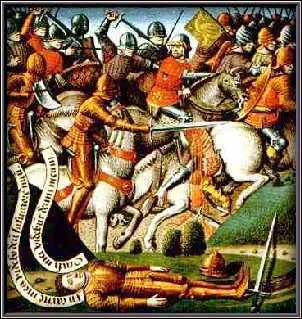
The Battle of Roncevaux Pass (French and English spelling, Roncesvalles in Spanish, Orreaga in Basque) in 778 saw a large force of Basques ambush a part of Charlemagne's army in Roncevaux Pass, a high mountain pass in the Pyrenees on the present border between France and Spain, after his invasion of the Iberian Peninsula. The Basque attack was in retaliation for Charlemagne's destruction of the city walls of their capital, Pamplona. As the Franks retreated across the Pyrenees back to Francia, the rearguard of Frankish lords was cut off, stood its ground, and was wiped out. Among those killed in the battle was Roland, a Frankish commander. His death elevated him and the paladins, the foremost warriors of Charlemagne's court, into legend, becoming the quintessential role model for knights and also greatly influencing the code of chivalry in the Middle Ages. The Battle of Roncevaux Pass was the only significant defeat of Charlemagne in his military career, and he would never take it upon himself to lead an army to battle in Spain, having to rely instead on his generals for future campaigns. There are numerous written works about the battle, some of which change and exaggerate events. The battle is recounted in the 11th century The Song of Roland, the oldest surviving major work of French literature, and in Orlando Furioso, one of the most celebrated works of Italian literature. Modern adaptations of the battle include books, plays, works of fiction, and monuments in the Pyrenees.
Also on this shelf
Antoine Virgile Schneider.
Economic and logistical aspects of the Napoleonic Wars.
See also
Uncatalogued shelfText from Wikipedia; plate via Wikimedia Commons. Text CC BY-SA 4.0; plate freely licensed (see Commons). Source record. Images and catalogue data are reproduced from open-access collections.