Arms and Armour
Drabant Corps of Charles XII
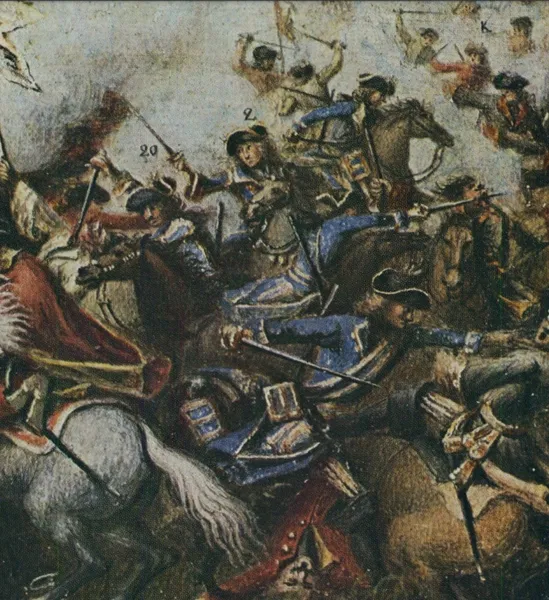
The Drabant Corps of Charles XII (Swedish: Karl XII:s Drabantkår) was the most prestigious cavalry king's guard unit in the Swedish Army during the time of the Great Northern War that specialized in cold-weather warfare, escort King Charles XII of Sweden, flanking maneuver, flying wedge formations, frontal assault, hand-to-hand combat, maneuver warfare, raiding with cavalry tactics, and screening. As a result of the reforms of 1700, all personnel in the corps received an officer's rank with increased wages, while its size was eventually set at 168 men. Those serving as Drabants were almost exclusively recruited from the Swedish Empire, with most coming from Sweden. The corps was issued the finest weapons, horses, and clothing was often adorned with gold lacing. They fought according to the cavalry regulations of the Caroleans, emphasizing the cold-steel charge in slight wedge formations, knee behind knee, over the more common caracole. This strategy allowed them to function as a bodyguard for the king as well as an elite combat unit, often playing a crucial role in the battles despite their relatively small size. During the war, the corps frequently marched with the main army and the king, fighting in most battles. The Drabants took part in the Landing at Humlebæk against Denmark in 1700, but did not see action. They were sent to Swedish Livonia and Estonia later the same year along with the main army, and won a decisive victory at Narva over the Russians. They took part in the Crossing of the Düna and were instrumental to the Swedish success in the battle over the Saxons. The victory was followed by the Swedish invasion of the Polish–Lithuanian Commonwealth, resulting in the successful Battle of Kliszów in 1702, where the Drabants fought in the cavalry engagement on the right flank. The Drabants, along with the king's army, then dealt two blows to Augustus II's cavalry and infantry in the engagements at Pułtusk and Thorn, respectively. In 1704, the corps took part in the Storming of Lemberg and, as the Saxons were chased out of Poland, the annihilation of a Russian force at Tillendorf. After quartering at Rawicz, the Drabants skirmished near Grodno in 1706, as Charles XII was starving the Russians out.
Also on this shelf
Battle of the Little Bighorn.
Fort Mifflin.
See also
Uncatalogued shelfText from Wikipedia; plate via Wikimedia Commons. Text CC BY-SA 4.0; plate freely licensed (see Commons). Source record. Images and catalogue data are reproduced from open-access collections.