Arms and Armour
British Army during the French Revolutionary and Napoleonic Wars
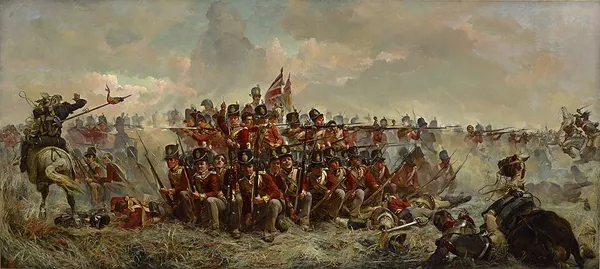
The British Army during the French Revolutionary and Napoleonic Wars experienced a time of rapid change. At the beginning of the French Revolutionary Wars in 1793, the army was a small, awkwardly administered force of barely 40,000 men. By the end of the Napoleonic Wars, the numbers had vastly increased. At its peak, in 1813, the regular army contained over 250,000 men. The British infantry was "the only military force not to suffer a major reverse at the hands of Napoleonic France." Unlike most French cavalry troopers who after 1805 received a bare 2 to 3 weeks of training, being prosperous if they were taught basic horsemanship and drill, the British trooper received a minimum of 6 months' training. Because the French could not withdraw from continental conflict as easily as the British (due to the latter's geographic location) and were forced to wage one war after another, they often did not have time to properly train their recruits. The British Army during the Napoleonic Wars, along with the Grande Armée, was considered one of the most modernized of its time and was among the finest in military history, thanks to a large number of volunteers (who were more effective than recruits), good training, strong weaponry (such as the Baker rifle or the Congreve rocket), many skilled commanders, and appropriate tactics. The army did not fight a major clash directly with the Grande Armée formation, which was resolutely involved only in the wars of the Third, Fourth, Sixth coalitions and in the invasion of Russia. Despite all the advantages, the quality of this army sacrificed its quantity: the army was not large enough to stand against France alone, even at the peak. It preferred to operate en masse only on secondary fronts such as the Netherlands (i.e., the 1799 invasion and Walcheren) and the Iberian Peninsula (the Peninsular War). During the Flanders campaign, the Netherlands front was the main one, however; both Prussia and Austria assisted Britain. At the Battle of Waterloo, there were 26 infantry brigades with only 9 were British.
Also on this shelf
.43 Spanish.
Bombard (weapon).
See also
Uncatalogued shelfText from Wikipedia; plate via Wikimedia Commons. Text CC BY-SA 4.0; plate freely licensed (see Commons). Source record. Images and catalogue data are reproduced from open-access collections.