Arms and Armour
Military of the Han dynasty
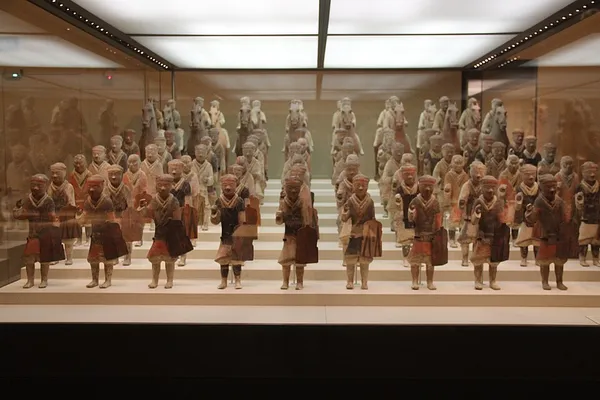
The military of the Han dynasty was the military apparatus of China from 202 BC to 220 AD, with a brief interregnum by the reign of Wang Mang and his Xin dynasty from 9 AD to 23 AD, followed by two years of civil war before the reestablishment of the Han dynasty. Han armies consisted primarily of infantry and cavalry, with minor use of chariots that became obsolete during the Western Han (202 BC – 9 AD). The Han naval forces included marines on tower ships built for inland riverine and lake battles rather than overseas ventures. To the north along the eastern Eurasian Steppe, the Han dynasty fought against nomadic confederations such as the Xiongnu, Xianbei, and Wuhuan. To challenge these migratory peoples effectively, the Han Empire was compelled to develop, train, and supply large amounts of cavalry and mounted forces. The Han-Xiongnu Wars that began during the reign of Emperor Gaozu of Han reached a turning point during the reign of Emperor Wu of Han, whose forces pushed the rival Xiongnu westward with the conquest of the Gansu corridor and establishment of the Protectorate of the Western Regions over the Tarim Basin of Central Asia. Weapons such as the crossbow gave Han forces a slight advantage against armies that lacked them.
Also on this shelf
Flagstaff War.
Erwin Rommel.
See also
Uncatalogued shelfText from Wikipedia; plate via Wikimedia Commons. Text CC BY-SA 4.0; plate freely licensed (see Commons). Source record. Images and catalogue data are reproduced from open-access collections.