Arms and Armour
Battle of the Little Bighorn
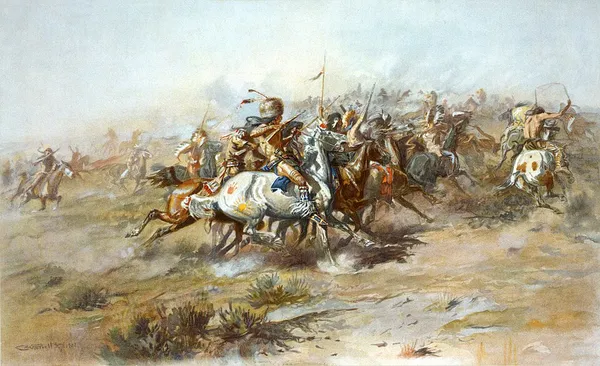
The 1876 Battle of the Little Bighorn, commonly referred to as Custer's Last Stand and known to the Lakota and other Plains Indians as the Battle of the Greasy Grass, was an armed engagement between combined forces of the Lakota Sioux, Northern Cheyenne, and Arapaho tribes and the 7th Cavalry Regiment of the United States Army. It took place on June 25–26, 1876, along the Little Bighorn River in the Crow Indian Reservation in southeastern Montana Territory. The battle, which resulted in the defeat of U.S. forces, was the most significant action of the Great Sioux War of 1876. Most battles in the Great Sioux War, including the Battle of the Little Bighorn, were on lands those natives had taken from other tribes since 1851. The Lakota were there without consent from the local Crow tribe, which had a treaty claim on the area. Already in 1873, Crow chief Blackfoot had called for U.S. military actions against the native intruders. The steady Lakota incursions into treaty areas belonging to the smaller tribes were a direct result of their displacement by the United States in and around Fort Laramie, as well as in reaction to white encroachment into the Black Hills, which the Lakota consider sacred. This pre-existing Indian conflict provided a useful wedge for colonization and ensured the United States a firm Indian alliance with the Arikaras and the Crows during the Lakota Wars. The fight was an overwhelming victory for the Lakota, Northern Cheyenne, and Arapaho, who were led by several major war leaders, including Crazy Horse and Chief Gall and had been inspired by the visions of Sitting Bull (Tȟatȟáŋka Íyotake). The U.S. 7th Cavalry, a force of 700 men commanded by Lieutenant Colonel George Armstrong Custer (a brevetted major general during the American Civil War), suffered a major defeat. Five of the 7th Cavalry's twelve troops were wiped out and Custer was killed, as were two of his brothers, his nephew, and his brother-in-law. The total U.S. casualty count included 268 dead and 55 severely wounded (six died later from their wounds), including four Crow Indian scouts and at least two Arikara Indian scouts. Public response to the Great Sioux War varied in the immediate aftermath of the battle.
Also on this shelf
Achilles.
Ahmad ibn Ibrahim al-Ghazi.
See also
- ▸Battle of Cedar Creek
- ▸Brahmapur railway station
- ▸89th Light Anti-Aircraft Regiment, Royal Artillery
Text from Wikipedia; plate via Wikimedia Commons. Text CC BY-SA 4.0; plate freely licensed (see Commons). Source record. Images and catalogue data are reproduced from open-access collections.