Arms and Armour
Capture of Trônes Wood
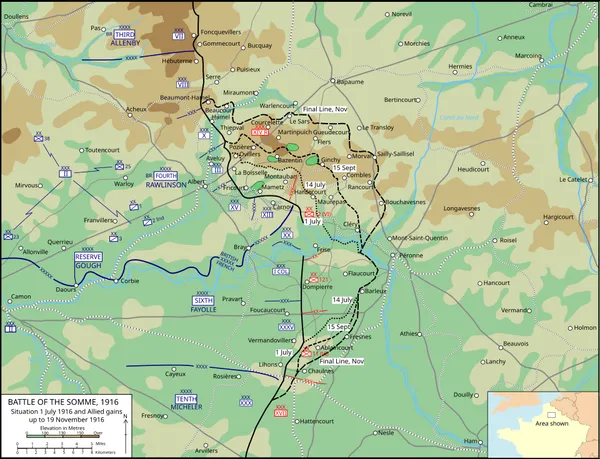
The Capture of Trônes Wood (8–14 July 1916) was a tactical incident in the First World War, fought by the British Fourth Army and the German 2nd Army, during the Battle of the Somme of 1916. Trônes Wood lay on the northern slope of Montauban ridge, between Bernafay Wood and Guillemont. The wood dominated the southern approach to Longueval and Trônes Alley, a German communication trench between Bernafay Wood and the northern tip of Trônes Wood to Guillemont. A light railway ran through the centre, which was in a dip formed by the east end of Caterpillar Valley sloping away to the west. The wood was pear-shaped, with a base about 400 yd (370 m) wide on Montauban ridge, the rest of the wood running north for about 1,400 yd (1,300 m), coming to a point on a rise towards Longueval village. The wood had dense undergrowth which impeded movement, made it difficult to keep direction and during the battle the trees were brought down by shellfire, becoming entangled with barbed wire and strewn with German and British dead. The British attacks were part of preliminary operations, to reach ground from which to begin the second British general attack of the Battle of the Somme, against the German second position from Longueval to Bazentin le Petit on 14 July. The German defenders fought according to a policy of unyielding defence and immediate counter-attack to regain lost ground, intended to delay the Anglo-French advance south of the Albert–Bapaume road and give time for reinforcements sent to the Somme front to arrive.
Also on this shelf
Godert de Ginkel, 1st Earl of Athlone.
21st Waffen Mountain Division of the SS Skanderbeg.
See also
Uncatalogued shelfText from Wikipedia; plate via Wikimedia Commons. Text CC BY-SA 4.0; plate freely licensed (see Commons). Source record. Images and catalogue data are reproduced from open-access collections.