Arms and Armour
Battle of Marathon
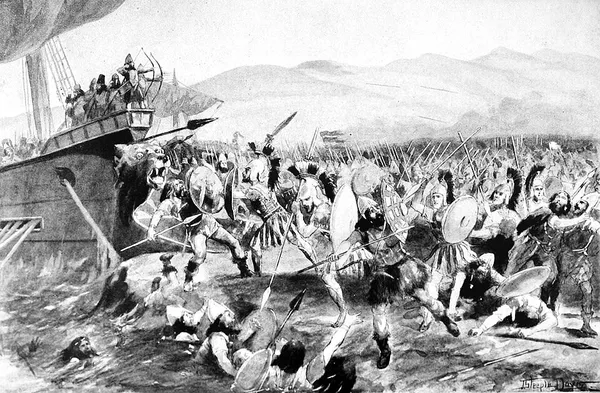
The Battle of Marathon took place in 490 BC during the first Persian invasion of Greece. It was fought between the citizens of Athens, aided by Plataea, against a Persian force commanded by Datis and Artaphernes. The battle was the culmination of the first attempt by Persia under King Darius I to subjugate Greece. The Greek army inflicted a crushing defeat on the more numerous Persians, marking a turning point in the Greco-Persian Wars. The first Persian invasion was a response to Athenian involvement in the Ionian Revolt, when the city-states of Athens and Eretria each sent a force to support the cities of Ionia in their attempt to overthrow Persian rule. The Athenians and Eretrians had succeeded in capturing and burning Sardis, but they were then forced to retreat with heavy losses. In response to this raid, Darius swore to burn down the two cities that had aided the failed revolt. According to Herodotus, Darius had his bow brought to him and then shot an arrow "upwards towards heaven", saying as he did so: "Zeus, that it may be granted me to take vengeance upon the Athenians!" Herodotus further writes that Darius charged one of his servants to say "Master, remember the Athenians" three times before dinner each day. At the time of the battle, Sparta and Athens were the two largest city-states in Greece. Once the Ionian revolt was finally crushed by the Persian victory at the Battle of Lade in 494 BC, Darius began making plans to subjugate Greece. In 490 BC, he sent a naval task force under Datis and Artaphernes across the Aegean Sea, to subjugate the Cyclades islands and then to make punitive attacks on Athens and Eretria. Reaching the island of Euboea in mid-summer after a successful campaign in the Aegean, the Persians proceeded to besiege and capture Eretria. The Persian force then sailed for Attica, landing in the bay near the town of Marathon. The Athenians, joined by a small force from Plataea, marched to Marathon, and succeeded in blocking the two exits from the plain of Marathon. The Athenians also sent a message to the Spartans asking for support.
Also on this shelf
Harquebusier.
Battle of Mount Harriet.
See also
Uncatalogued shelfText from Wikipedia; plate via Wikimedia Commons. Text CC BY-SA 4.0; plate freely licensed (see Commons). Source record. Images and catalogue data are reproduced from open-access collections.