Arms and Armour
Grand Slam (bomb)
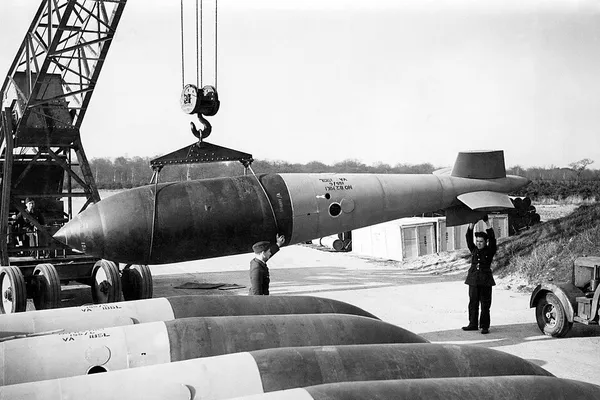
The Bomb, Medium Capacity, 22,000 lb (Grand Slam) was a 22,000 lb (10,000 kg) earthquake bomb used by RAF Bomber Command against German targets towards the end of the Second World War. The bomb was originally called Tallboy Large until the term Tallboy got into the press and the code name was replaced by "Grand Slam". The bomb was similar to a large version of the Tallboy bomb but a new design and closer to the size that its inventor, Barnes Wallis, had envisaged when he developed the idea of an earthquake bomb. It was the largest and most powerful conventional (non-nuclear) aerial bomb used by either side during the war. Medium Capacity (MC) bombs were designed to remedy the shortcomings of General Purpose (GP) bombs, with a greater blast and casings which were robust enough to confer a considerable capacity to penetrate, especially the Tallboy and Grand Slam. The Grand Slam case was made of a chrome-molybdenum alloy steel, with the charge constituting over 43 per cent of the bomb's weight. Standard Avro Lancaster bombers could not carry the bomb; Avro built 32 Lancaster B.Mk 1 (Special)s with more powerful Merlin engine variants, a stronger undercarriage, without bomb bay doors and minus many items to save weight. When airborne with the Grand Slam, a Special could barely manoeuvre and pilots were advised to refrain from minor adjustments of the flying controls, allowing the aircraft to wallow. A Lancaster which returned with its bomb was not permitted to land at RAF Woodhall Spa, the 617 Squadron base; it had to use the longer runway at RAF Carnaby. From 14 March to 19 April 1945, 42 Grand Slams were dropped on Germany. When landing on reinforced concrete, the bombs tended to break up or explode prematurely. The bombs had been designed to land in soft ground, penetrate deeply and then explode, creating a camouflet, causing the structure above to subside. Grand Slams were the largest bombs by explosive yield used by the Allies until the advent of atomic weapons later that year but remained the largest by weight until the deployment of the T-12 Cloudmaker in 1949. After the war, the Royal Air Force and United States Army Air Forces used Grand Slams and other bombs for research.
Also on this shelf
Heraklion.
Alcazaba of Málaga.
See also
Uncatalogued shelfText from Wikipedia; plate via Wikimedia Commons. Text CC BY-SA 4.0; plate freely licensed (see Commons). Source record. Images and catalogue data are reproduced from open-access collections.