Arms and Armour
Exhumation and reburial of Richard III of England
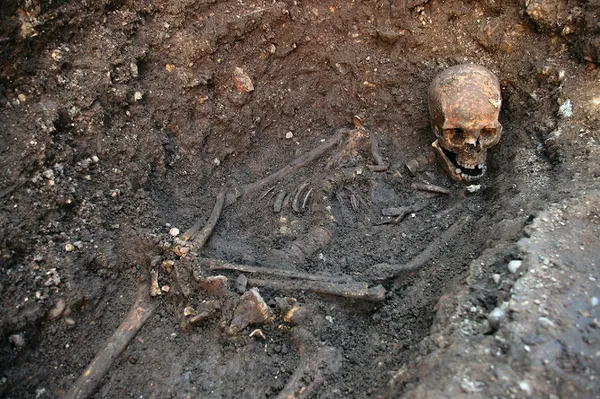
On 25 August 2012, in Leicester, England, the remains of Richard III, the last English king killed in battle and last king of the House of York, were discovered within the site of the former Greyfriars Friary. Following extensive anthropological and genetic testing, the remains were reinterred at Leicester Cathedral on 26 March 2015. Richard III, the final ruler of the Plantagenet dynasty, was killed on 22 August 1485 in the Battle of Bosworth Field, the last significant battle of the Wars of the Roses. His body was taken to Greyfriars, where it was buried in a crude grave in the friary church. Following the friary's dissolution in 1538 and subsequent demolition, Richard's tomb was lost. An erroneous account arose that Richard's bones had been thrown into the River Soar at the nearby Bow Bridge. A search for Richard's body began in August 2012, initiated by Philippa Langley and the Looking for Richard project with the support of the Richard III Society. The archaeological excavation was led by University of Leicester Archaeological Services, working in partnership with Leicester City Council. On the first day, a human skeleton belonging to a man in his thirties was uncovered showing signs of severe injuries. The skeleton, which had several unusual physical features, most notably scoliosis, a severe curvature of the spine, was exhumed to allow scientific analysis. Examination showed that the man had probably been killed either by a blow from a large bladed weapon, probably a halberd, which cut off the back of his skull and exposed the brain, or by a sword thrust that penetrated all the way through the brain. Other wounds on the skeleton had probably occurred after death as "humiliation injuries", inflicted as a form of posthumous revenge. The age of the bones at death matched that of Richard when he was killed; they were dated to about the period of his death and were mostly consistent with physical descriptions of the king. Preliminary DNA analysis showed that mitochondrial DNA extracted from the bones matched that of two matrilineal descendants, one 17th-generation and the other 19th-generation, of Richard's sister Anne of York.
Also on this shelf
Dunboy Castle.
3rd Canadian Division.
See also
Uncatalogued shelfText from Wikipedia; plate via Wikimedia Commons. Text CC BY-SA 4.0; plate freely licensed (see Commons). Source record. Images and catalogue data are reproduced from open-access collections.