Arms and Armour
Big Bertha (howitzer)
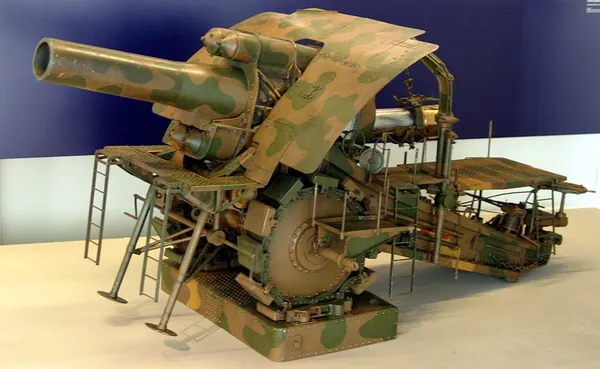
The 42 centimeter kurze Marinekanone 14 L/12 (short naval cannon), or Minenwerfer-Gerät (M-Gerät), popularly known by the name of Big Bertha, was a German siege howitzer built by Krupp AG in Essen, Germany and fielded by the Imperial German Army from 1914 to 1918. The M-Gerät had a 42 cm (17 in) calibre barrel, making it one of the largest artillery pieces ever fielded. The M-Gerät designed in 1911 as an iteration of earlier super-heavy German siege guns intended to break modern fortresses in France and Belgium and entered production in 1912. Test firing began in early 1914 and the gun was estimated to be finished by October 1914. When the First World War broke out, the two M-Gerät guns, still prototypes, were sent to Liège, Belgium, and destroyed Forts Pontisse and Loncin. German soldiers bestowed the gun with the nickname "Big Bertha", which then spread through German newspapers to the Allies, who used it as a nickname for all super-heavy German artillery. The Paris Gun, a railway gun used to bomb Paris in 1918, has historically been confused for the M-Gerät. Due to losses from faulty ammunition and Allied counter-battery artillery, a smaller-calibre (30.5 cm (12.0 in)) gun called the Beta-M-Gerät was built and fielded from 1916 until the end of the war. It had a longer and heavier barrel that was mated to the M-Gerät's carriage but was found to be less effective than the base gun.
Also on this shelf
Battle of the Herrings.
Farringdon's Battery.
See also
Uncatalogued shelfText from Wikipedia; plate via Wikimedia Commons. Text CC BY-SA 4.0; plate freely licensed (see Commons). Source record. Images and catalogue data are reproduced from open-access collections.