Arms and Armour
Battle of Agincourt
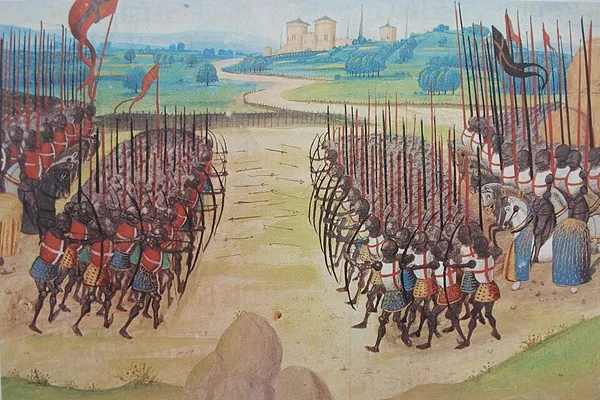
The Battle of Agincourt ( AJ-in-kor(t); French: Azincourt [azɛ̃kuʁ]) was an English victory in the Hundred Years' War (1337–1453). It took place on 25 October 1415 (Saint Crispin's Day) near Azincourt, in northern France. The unexpected victory of the vastly outnumbered English troops over the French army boosted English morale, crippled France, and began a new period of English dominance in the war. This advantage lasted for 14 years, until England was defeated by France in 1429 during the Siege of Orléans. After several decades of relative peace, the English had resumed the war in 1415 amid the failure of negotiations with the French. In the ensuing campaign, many soldiers died from disease, and the English numbers dwindled during the Siege of Harfleur; they attempted to withdraw to English-held Calais but found their path blocked by a considerably larger French army. Despite their numerical disadvantage, the battle ended in an overwhelming victory for the English. King Henry V of England led his troops into battle and participated in hand-to-hand fighting. King Charles VI of France did not command the French army as he suffered from psychotic illnesses and associated mental incapacity. The French were commanded by Constable Charles I d'Albret and various prominent French noblemen of the Armagnac party. This battle is notable for the extensive use of the English longbow, as English and Welsh archers comprised nearly 80 percent of Henry's army. The Battle of Agincourt is one of England's most significant triumphs in the Hundred Years' War, alongside the Battle of Crécy (1346) and the Battle of Poitiers (1356). The battle serves as the backdrop for notable works such as William Shakespeare's play Henry V, written in 1599.
Also on this shelf
Battering ram.
Capture of Trônes Wood.
See also
Uncatalogued shelfText from Wikipedia; plate via Wikimedia Commons. Text CC BY-SA 4.0; plate freely licensed (see Commons). Source record. Images and catalogue data are reproduced from open-access collections.